
Contents
Overview
What a pick and carry crane is
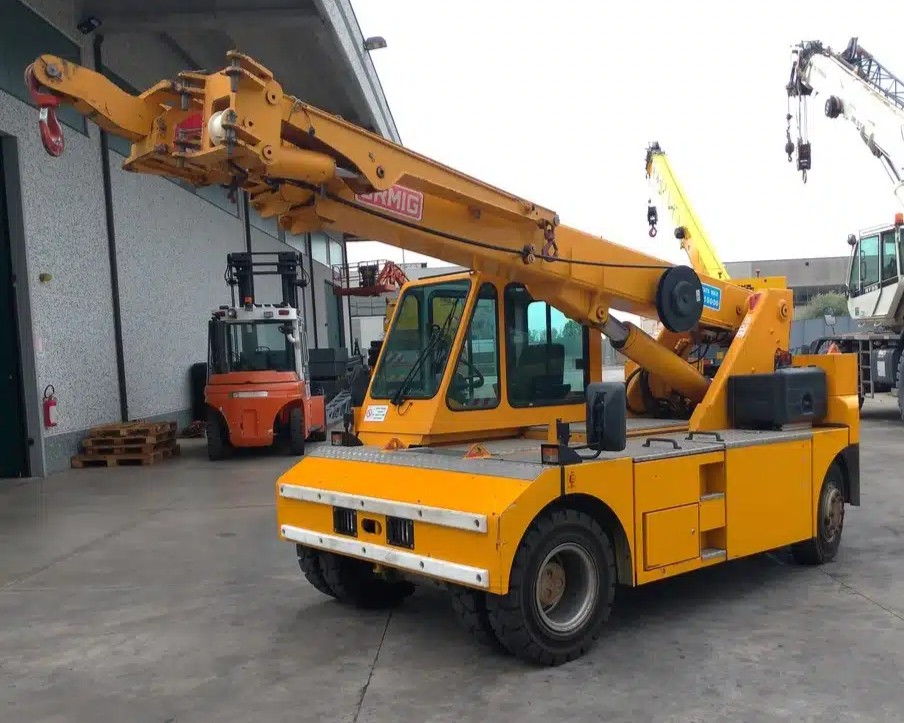
A pick and carry crane is a mobile crane that can lift a load and drive with it, without setting up outriggers first. That one feature is what makes it useful: it can pick a machine up in one place, carry it across a factory floor and set it down somewhere else, in spaces where a conventional mobile crane could never set up.
In short
- A pick and carry crane lifts on its wheels, with no outriggers, and can travel with the load on the hook.
- Compact electric models are battery powered, produce no fumes and run on non-marking tyres, so they work inside buildings.
- They are used for machinery installation, moving machines within a site, plant maintenance and lifting in tight spaces.
- Capacity falls as the boom extends, so every lift is checked against the load chart.
We run a fleet of electric pick and carry cranes from 5 to 12 tonnes. You can see them on our electric pick and carry crane hire page. This guide explains how the cranes work, what they are good for and what to plan around.
How it works
How a pick and carry crane works
Most mobile cranes lift from outriggers: legs that extend from the chassis and take the weight of the crane and its load. A pick and carry crane is built to lift without them.
Lifting without outriggers
The crane is stable on its own wheels and chassis, using its own weight as counterbalance. With no outriggers to deploy, it needs far less space to set up, and it can start lifting as soon as it is in position.
Travelling with the load
Once the load is lifted, the crane can drive with it, carrying it low and slowly to where it needs to go. That lets one machine do the lift, the move and the placement, instead of handing the load between a crane, a forklift and skates.
Load charts
Every pick and carry crane has a load chart showing what it can lift at each boom length and angle. The headline capacity applies only with the boom close in. As the boom extends, the safe working load drops. Where a crane has separate duties for travelling with the load, the chart shows those too. That is why the weight of the load and the reach needed come first in any enquiry.
Electric
Electric pick and carry cranes for indoor work
Pick and carry cranes range from large diesel machines that travel on public roads, such as city cranes with pick and carry duties, to compact electric cranes designed for factory floors. Electric models are the ones that change what is possible indoors.
No fumes
Battery power means no exhaust inside the building. That matters on food and pharmaceutical sites, in clean areas and anywhere people carry on working near the lift.
Non-marking tyres
Non-marking tyres protect finished and painted floors, so the crane can work in production areas without leaving a mess behind.
Compact size
Our electric cranes are between 1.4m and 2.21m wide, small enough to pass through many standard industrial doors and work between machines.
| Crane | Max capacity | Width | Height | Max boom extension |
|---|---|---|---|---|
| Valla 50E | 5,000kg | 1.4m | 2.0m | 4.88m |
| Valla 75E | 7,500kg | 1.73m | 2.29m | 5.4m |
| Ormig 10tmE | 10,000kg | 2.21m | 2.17m | 8.5m |
| Valla 120E | 12,000kg | 2.1m | 2.32m | 7.2m |
Maximum capacity is at the shortest reach. Check the load chart on each crane’s page for the capacity at the radius you need.
Uses
What pick and carry cranes are used for
Pick and carry cranes earn their place wherever a load needs lifting and moving in a space too tight, too low or too busy for a conventional crane.
- Machinery installation: lifting new machines off transport and placing them on their bases. See machine delivery and installation.
- Moving machines within a site: relocating equipment from one bay to another as part of a new layout. See machine movement.
- Plant maintenance: lifting motors, gearboxes, rolls and other components out for repair and back in again.
- Factory moves: loading and unloading machines at both ends of a relocation. Our guide on how to plan a factory relocation covers the planning.
- Confined spaces: plant rooms, low-headroom areas and gaps between live production lines.
Planning
What to plan around
A pick and carry crane is flexible, but it is still a crane. These are the checks we make before any lift.
Floor loading
Without outriggers to spread the load, the crane’s weight and the load it carries go through its wheels. The floor along the whole route, not just at the lift position, has to take those wheel loads, including over any trenches, drains or suspended slabs.
Capacity at reach
If the load has to be placed over an obstruction or at the back of a machine bed, the reach needed can take a larger crane than the weight alone suggests.
The travel route
The route should be level, firm and clear. Slopes, ramps and uneven floors reduce what the crane can safely carry, so the route is planned as carefully as the lift.
Doors and headroom
Measure door openings, headroom and any overhead services such as pipework, cable trays and crane beams, both for the crane getting in and for the boom height during the lift.
Hiring
Hiring a pick and carry crane
Our pick and carry cranes are available on short and long term hire, with a trained operator. Lifts are planned to BS 7121, and our operators are CPCS or NPORS carded.
Planning is a legal duty. Under regulation 8 of the Lifting Operations and Lifting Equipment Regulations 1998 (LOLER), every lifting operation must be properly planned by a competent person, appropriately supervised and carried out in a safe manner. The HSE’s LOLER guidance sets out what that means in practice.
Crane hire or contract lift
You can hire the crane with an operator and manage the lift yourself, or we can plan and carry out the whole lift on a contract lift basis. Our guide to crane hire or a contract lift explains who is responsible for what under each.
What we need to know
- The weight and dimensions of the load, and where its lifting points are
- How far it has to be lifted, carried and reached
- Door sizes, headroom and the route from the entrance to the lift
- The floor construction along the route
Questions
Common questions
Can a pick and carry crane be used indoors?
Yes. Electric pick and carry cranes are designed for it: they run on batteries with no exhaust fumes and have non-marking tyres, so they can work inside factories, warehouses and plant rooms.
How much can a pick and carry crane lift?
Our electric pick and carry cranes lift from 5 to 12 tonnes at their shortest reach, and we can supply larger pick and carry and city cranes up to 60 tonnes. What a crane can lift on the day depends on the reach and the duties on its load chart, so every lift is checked against it.
Do I need an operator?
Yes. A pick and carry crane must be operated by a trained, competent operator. We supply ours with CPCS or NPORS carded operators.
Is a pick and carry crane the same as a mini crane?
Not quite. Most mini and spider cranes lift from outriggers and stay put during the lift, while a pick and carry crane is designed to lift on its wheels and travel with the load.
Get a quote
Get a quote for pick and carry crane hire
Call us on 0800 008 6096 or email office@synergy-lifting.co.uk. Tell us what the load is, how far it needs to move and what the access is like, and we will recommend the right crane.
Find out more about our electric pick and carry crane hire, machine movement and crane hire and contract lifting services.
Related
Find out more
Get a quote
Ready for a quote?
Send us the details and we will come back with a quote, usually the same day for a desktop survey.
Or call 0800 008 6096