

Contents
Overview
What size outrigger mats does a crane need?
The outrigger mats a crane needs are sized from two figures: the heaviest load on any outrigger, from the crane maker’s data, and the pressure the ground can carry, from a competent person’s assessment. As a first check, load divided by that pressure gives each mat’s least area. The lift planner then checks the mat’s stiffness and the ground below.
Outrigger mats, also called crane mats or spreader mats and often sold as outrigger pads, go under the crane’s own pad at the foot of each outrigger. By spreading each outrigger’s load over more ground they lower the ground bearing pressure, so the ground can hold the crane and its load without sinking or giving way.
In short
- An outrigger load can be higher with nothing on the hook than during a lift, because of the counterweight behind the crane. CPA guidance has the crane supplier give figures for rigging as well as for each planned lift.
- Doubling a mat’s area halves the pressure under it, but only when the mat is stiff enough to spread the load out to its edges.
- In Great Britain, LOLER requires lifting equipment to be stable enough for each load, and HSE’s guidance in L113 names the ground’s strength as one factor in that stability.
- Under CPA guidance the customer assesses and prepares the ground, on crane hire and on a contract lift alike, and the crane supplier gives the outrigger loads.
Our crane hire and contract lifting service supplies mobile cranes with operators, and our lifts are planned to BS 7121.
Sources
Where this guidance comes from
The general rules in this guide come from LOLER, HSE’s code of practice and guidance L113, the code of practice for mobile cranes BS 7121-3 and guidance from the Construction Plant-hire Association (CPA), the trade association for plant hire. Each one is named where it is used.
Outrigger loads and crane weights differ for every crane, and for every configuration of the same crane, so each maker publishes its own. Where this guide gives one, it names the maker and model as an example. For a real lift, use the figures and instructions the maker gives for that crane in that set-up, and have the ground assessed and the lift planned by a competent person.
Outrigger loads
What outrigger loads are
Outriggers are the legs a mobile crane extends and lowers before it lifts, raising its wheels off the ground so that it stands on a pad at the foot of each leg. Everything the crane weighs, and everything it lifts, then reaches the ground through those pads. The force on each pad is its outrigger load, and it changes all through the lift.
The loads shift from one outrigger to another as the crane slews, so the CPA’s guidance on supplying mobile cranes asks the supplier for each outrigger’s highest point load through a full 360° slew while rigging, and for every planned lift. The guide Ground conditions for construction plant, written for the Strategic Forum for Construction and published by the CPA in 2014, explains why rigging matters: with nothing on the hook at the shortest radius, the counterweight pressing down behind the crane can make an outrigger load higher than it is during a lift. The same guide notes that makers’ outrigger loads for mobile cranes may leave out the effect of wind on the crane, and says to check with the maker.
Makers give these figures in the crane’s documents. Under BS EN 13000, the design standard for mobile cranes, the maker’s manual sets out the reaction forces on the crane’s supports and what the outriggers need, and has the user check the ground can take the highest loading. How far the outriggers are extended also changes what the crane can lift, which our guide How to Read a Crane Load Chart explains.
How heavy is a mobile crane?
Every outrigger load starts with the crane’s own weight. These road weights are the makers’ own published figures:
| Crane | Maximum capacity | Weight on the road (maker’s figure) |
|---|---|---|
| Terex Demag AC 30 City, city crane | 30 t, with the heavy-lift attachment | 22 t |
| Liebherr LTM 1040-2.1, all-terrain crane | 40 t | 24 t, with 1.5 t of counterweight |
| Grove GMK3060, all-terrain crane | 60 t | 35.47 t, with 6.6 t of counterweight |
| Liebherr LTM 1100-5.2, all-terrain crane | 100 t | 60 t, with 11.5 t of counterweight |
The load on the hook and any extra counterweight add to that. Liebherr lists up to 35 t of counterweight for the LTM 1100-5.2, against the 11.5 t included in its road weight, so on its outriggers the crane can carry up to 23.5 t more counterweight than it does on the road.
Ground bearing pressure
How ground bearing pressure is worked out
Ground bearing pressure is the load on a pad or mat divided by the area of ground beneath it. It is given in tonnes per square metre (t/m²) or kilonewtons per square metre (kN/m²), and 1 t/m² is about 9.81 kN/m².
The pressure only means something next to what the ground can carry, its bearing capacity. The CPA’s ground conditions guide says the pressure must be kept within an acceptable level for the surface and for the ground underneath it. These terms come up whenever mats are chosen:
| Term | What it means | Where the figure comes from |
|---|---|---|
| Outrigger load | The force one outrigger puts on the ground at a given moment | The crane maker’s data for that crane and configuration |
| Outrigger pad | The foot on the end of each outrigger, which is part of the crane | The maker’s specification |
| Outrigger mat | A larger mat laid under the crane’s pad to spread its load | Chosen when the lift is planned, to suit the load and the ground |
| Ground bearing pressure | Worked out as outrigger load ÷ area of the pad or mat | The outrigger load and the size of the pad or mat |
| Bearing capacity | The pressure the ground at the crane position can carry | A competent person’s assessment of the ground |
Mats
How outrigger mats spread the load
Without a mat, the whole outrigger load presses into the ground through the crane’s own pad. In the made-up example below that pad is 0.5 m square, a quarter of a square metre. A mat under the pad spreads the load over a bigger area, and the pressure falls in step: twice the area gives half the pressure.
That holds only while the mat stays flat. The CPA’s ground conditions guide points out that a mat can be strong enough and still bend, which pushes the load into a smaller area in its middle, and that a bigger mat will not always carry more where softer ground lies underneath. It also makes these points about mats:
- Thickness counts for a lot: doubling it gives four times the strength and eight times the stiffness.
- Two thin mats stacked carry about half as much as one mat of the same total thickness, because they slide over each other.
- The pad should sit in the centre of the mat.
- Steel and aluminium are the strongest and stiffest materials. Plastic mats are stronger than timber ones but bend more.
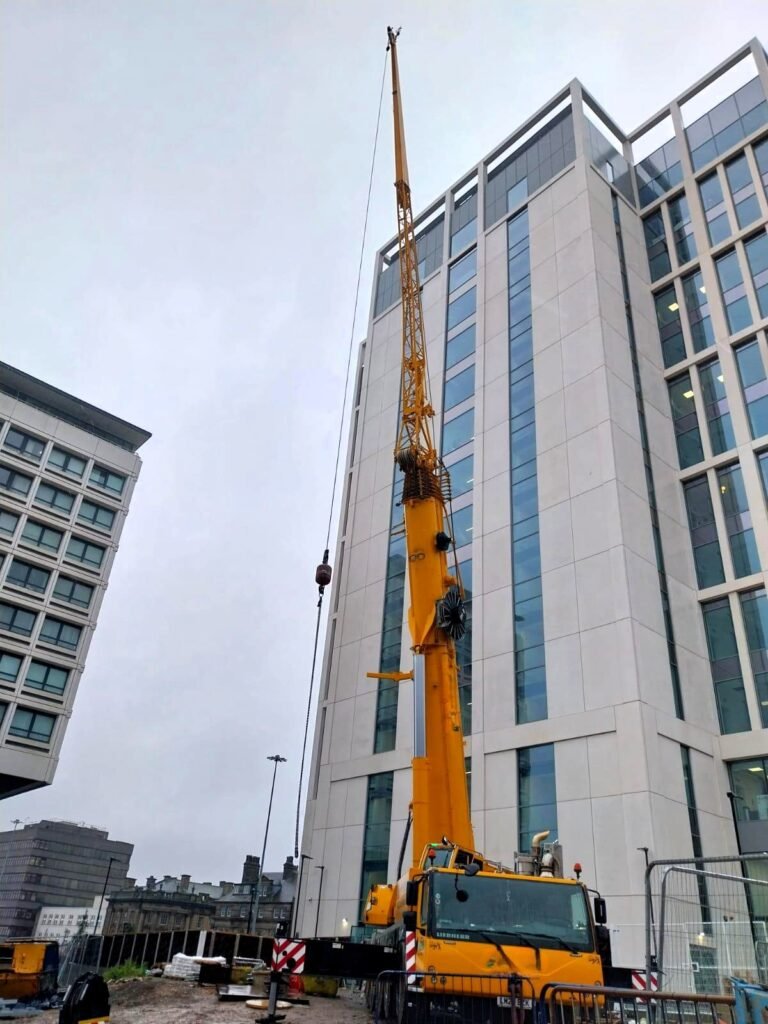
When a crane is supplied, the CPA’s supply guidance has the supplier set out the mats that come with it: the material, size, capacity and weight of each. Whether they are enough for the crane position depends on the ground assessment.
The ground
Who assesses the ground under a crane
In Great Britain, regulation 4 of LOLER requires employers to make sure lifting equipment is of adequate strength and stability for each load. HSE’s guidance in L113 lists the strength of the ground among the things that affect stability, and says spreader plates may be needed so the ground can support the equipment and the heaviest load it lifts.
For a mobile crane lift, BS 7121-3 has the appointed person, who plans the lift, get a competent person to assess whether the ground will carry the crane, working from the maker’s ground loadings. The appointed person role comes from the BS 7121 codes of practice. In Great Britain the law itself asks only for a competent person to plan the lift.
The CPA’s supply guidance leaves the ground with the crane user whichever contract is chosen, from assessing it to preparing it. On a contract lift, the crane user is the customer in control of the site. The supplier should provide accurate loadings from the crane, and the user establishes what the ground, and any structures and services in it, can bear. The CPA’s guidance on rigging mobile cranes says the same for a hired crane.
Those assessing the ground should know their own limits and when to stop and consult an expert, the CPA’s ground conditions guide says. Where a crane would stand on a suspended slab, BS 7121-3 has an engineer assess the structure.
On our contract lifts, our own appointed person plans the lift and writes the lift plan. We send the site the crane’s outrigger loads, details of the mats and our ground bearing pressure calculations for the crane position. The site then has its own competent person confirm the ground is suitable, because the site knows what lies beneath it, such as buried services or ground that has been built up, and our appointed person cannot know that from a survey. That keeps the ground with the customer, as the CPA guidance above does, and gives the appointed person the assessment BS 7121-3 asks for. CPA guidance makes the crane supplier responsible for the crane’s stability on the ground provided.
Under BS 7121-1 the plan records how the outriggers are supported, as our guide What is a lift plan? explains. The roles on a lift are covered in our guide Appointed Person and Other Lifting Roles.
Below ground
Underground voids and services
A mat spreads the load down into the ground as well as across its surface, so what lies underneath matters as much as the surface. HSE’s guidance on planning lifting operations warns against setting up too close to trenches and excavations, and against contact with buried services such as drains and sewers.
HSE’s guidance in L113 adds that where lifting equipment is too close to an excavation, the ground could sink slowly or give way suddenly. BS 7121-3 allows the pressure from a mat to be treated as spreading into the ground at 45° from its edges. On that basis the gap from the edge of the mat to an unsupported excavation should be greater than the excavation’s depth.

A supported edge, such as sheet piling, can allow a mat closer. The standard has the appointed person take expert advice if in doubt, as some sites call for a different angle.
Ground that has been dug out and backfilled needs particular care. The CPA’s ground conditions guide warns that backfill can mix soil types and vary in how well it is compacted, and says to assume a low compaction unless an actual figure is available.
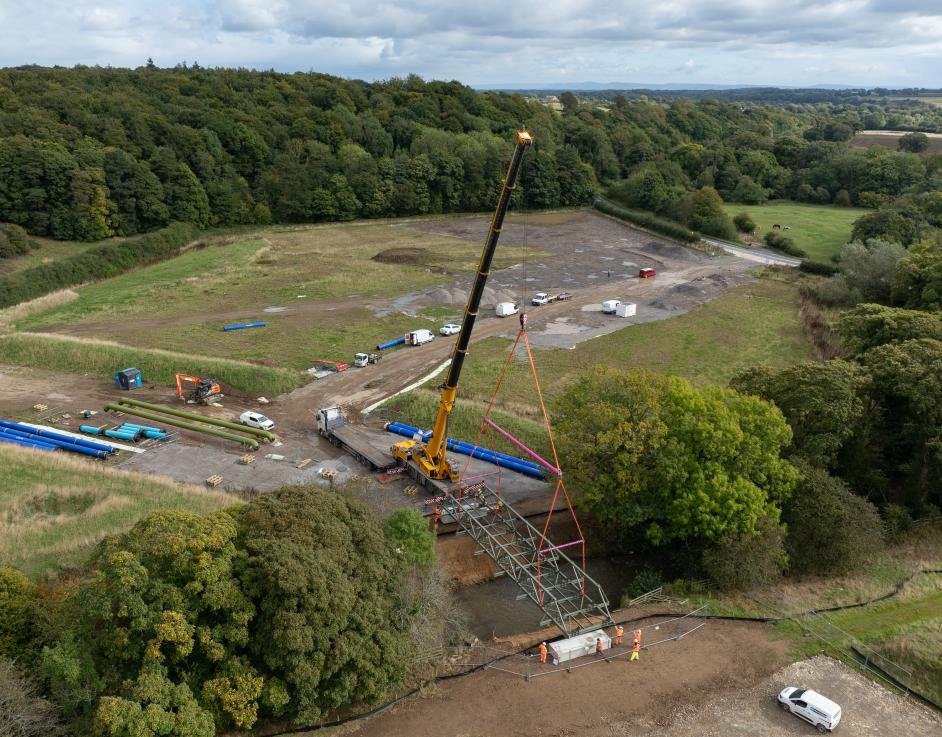
The CPA’s supply guidance calls knowledge of buried services and underground structures essential when positioning a crane, and has the hirer give the appointed person information on site conditions and hazards. Tell whoever plans the lift about any cellars, basements, drains or backfilled trenches near where the crane could stand. Getting the crane to that position and preparing the site are covered in our guide Crane Site Preparation: Getting Ready for a Mobile Crane.
Example
An outrigger mat example (a made-up job)
This example is invented, with round figures, to illustrate how the sum works. For the planned set-up, the crane maker’s data gives a highest load on any one outrigger of 40 t, across rigging and the lift, with the load and lifting gear on the hook. The crane’s own pads are 0.5 m square.
| Under the outrigger | Area carrying the load | Ground bearing pressure |
|---|---|---|
| The crane’s pad alone, 0.5 m by 0.5 m | 0.25 m² | 40 ÷ 0.25 = 160 t/m² |
| A mat 1 m by 1 m | 1 m² | 40 ÷ 1 = 40 t/m² |
| A mat 2 m by 2 m | 4 m² | 40 ÷ 4 = 10 t/m² |
Say the competent person’s assessment for this made-up crane position allowed 15 t/m². That figure is invented for the sum and is not a value for any real ground. Of the three, only the 2 m mat brings the pressure below the invented 15 t/m², at 10 t/m² (about 98 kN/m²), and only if the mat is stiff enough to spread the load over its whole area with no softer layer beneath. A real check also allows for uneven loading, the crane’s movements and wind, which this sum leaves out.
The sum only shows how the pressure falls as the area grows. For a real lift, the outrigger loads and the mat’s rating come from their makers, and a competent person must assess the real ground.
From our lifts
We send the site our outrigger loads, the mat details and the ground bearing pressure calculations for the crane position. The site’s own competent person then confirms the ground can take those loads. They know what’s under the surface, such as services, voids or built-up ground, and a survey from us can’t show that.
The mats that turn up are smaller or thinner than the plan asked for, or a mat goes down over a manhole cover or a freshly filled trench. Both get caught at set-up. When that happens the lift stops and the appointed person carries out a full re-evaluation of the plan. A quick change of crane position on the day isn’t the answer.
Find out what is under the crane position before you book. Old drawings and a service search tell the appointed person a lot, and so do manhole covers and patched tarmac. Send us that with the plan, and we can confirm which mats come with the crane and whether larger ones are needed.
Questions
Common questions
What are outrigger pads used for?
Outrigger mats, also sold as outrigger pads, spread the load from the crane’s own pads across more ground, so the pressure stays within what the ground can carry. Without enough area under each pad, the ground can sink or fail and the crane can lose stability. The size of each mat is set when the lift is planned.
What do you put under outriggers?
A mat sized for the outrigger load and the ground, made of timber, steel, aluminium or plastic. CPA guidance ranks steel and aluminium as the strongest and stiffest. Where the ground cannot take the load even with mats, the crane can move to firmer ground, or the ground can be improved to an engineer’s design.
How do you calculate outrigger pad size?
Divide the highest outrigger load from the crane maker by the bearing pressure a competent person has assessed, to get the least area the mat needs. In a made-up case, 40 t on ground assessed at 15 t/m² needs at least 2.7 m², so a 2 m square mat. The lift planner then checks the mat’s stiffness and rating.
Can outriggers be used without mats?
Only where a competent person’s assessment shows the ground can carry the outrigger loads through the crane’s own pads. In Great Britain, HSE’s guidance on LOLER in L113 says spreader plates may be needed for the ground to support the equipment and its heaviest load. Under BS 7121-1, the method statement records how each outrigger is supported.
What is ground bearing pressure?
It is the load pressing on the ground divided by the area carrying it, given in t/m² or kN/m². Under a mobile crane, it is each outrigger load divided by the area of the pad, or of the mat beneath it. It has to stay within the bearing capacity of the ground, which a competent person assesses.
How is ground bearing capacity tested?
A competent person assesses it from information about the site and its soil, such as records of what lies below and tests on site. The CPA’s ground conditions guide lists site tests including trial pits, soakage tests, penetrometer tests and hand vane tests, with laboratory tests where needed, and says assessors should know when to consult an expert.
Who is responsible for the ground under a crane?
In Great Britain, LOLER requires employers to make sure lifting equipment is stable enough for each load. CPA guidance leaves assessing and preparing the ground with the business using the crane, hired or on a contract lift. On our contract lifts, we send the site our outrigger loads and pressure calculations, and the site’s competent person confirms the ground.
How heavy is a mobile crane?
It depends on the crane. Makers’ road weights include 22 t for the Terex Demag AC 30 City, a 30 t city crane, and 60 t for the 100 t Liebherr LTM 1100-5.2. On site, extra counterweight and the load add to that, so outrigger loads come from the maker’s data for the set-up.
Get help
Get help with outrigger loads and mats
Call us on 0800 008 6096 or email office@synergy-lifting.co.uk. Send us photos or a site plan showing where the crane could stand and what you know about the ground beneath it. Tell us the weight of the load too. We will advise on the crane and quote for the lift.
Find out more about our crane hire and contract lifting service, or our lift and shift service.
Related
Find out more
Get a quote
Ready for a quote?
Send us the details and we will come back with a quote, usually the same day for a desktop survey.
Or call 0800 008 6096