

Contents
Overview
Planning chiller lifting and AHU lifts onto a roof
Chiller lifting onto a roof is planned from the maker’s data: what the unit weighs and how it must be rigged. The same goes for an air handling unit (AHU). From there the planner chooses a crane with enough reach over the building, then checks where the crane will stand and where the unit will land on the roof.
Rooftop plant also covers packaged air conditioning units and heat pumps, set on the roof itself or inside a rooftop plantroom.
In short
- Take the unit’s weight from its maker, then add the rigging and the crane’s hook block to get what the crane lifts.
- Rig only from the lifting points the maker marks, with any spreader or spacer bars its instructions call for.
- A crane on the public road needs a permit from the authority for that road, so its notice period belongs in the programme.
- On a contract lift, our own appointed person plans the lift and writes the lift plan.
We supply cranes for plant lifts through our crane hire and contract lifting service, and plan our lifts to BS 7121.
The unit
Weights and lifting points from the maker
In Great Britain, the duty to have each lift planned by a competent person comes from regulation 8 of LOLER. The weights and lifting instructions for a unit come from its maker, and they differ between makers and models. The makers named below are examples only: use the figures and instructions for your own unit.
HSE’s brief guide to lifting equipment asks, among its first planning questions, for the weight of the load and the position of its centre of gravity.
The weight
Daikin’s manual for its EWAD-T-B air cooled chillers sends the reader to the unit’s nameplate for its weight. Some data sheets give two figures. Yanmar’s data sheet for its Y-VHA air cooled chillers lists a shipping weight and a slightly higher operation weight for each model: 1,071 kg and 1,097 kg for the Y-VHA-P1.84.2-CH.
Use the weight of the unit as it will actually be lifted, including any transport cradle or packaging left on it, and ask the maker if the data sheet does not make clear which figure that is. The crane carries more than the unit, because the spreader beam, slings, shackles and the crane’s hook block (the weighted hook assembly on the end of its rope) all hang from it too, and our guide What size crane do I need? counts them in the same way.
Units that come in sections
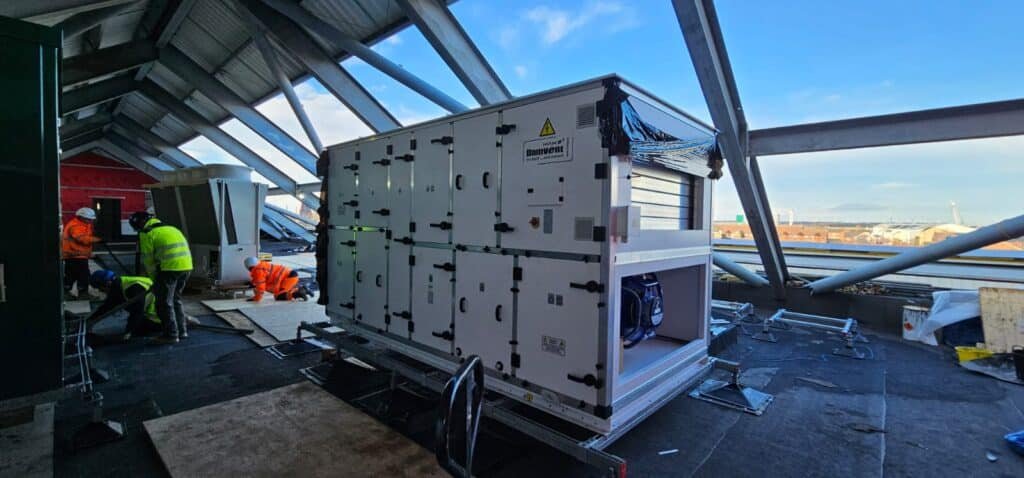
Large AHUs can arrive in sections that are lifted one at a time. Swegon’s installation instructions for its GOLD RX 70 and 80 give a separate lifting method for each section, and put the mounted heat exchanger section at about 1,000 to 1,200 kg.
Lifting points and spreaders
Daikin’s EWAD-T-B chillers come with their lifting points marked in yellow, and the manual allows no other points to be used for lifting. The same manual calls for spacing bars above the fan grilles to protect the condenser coils, and for the unit to be lifted very slowly and kept level.
Swegon’s instructions call for a line spreader, a bar that holds the slings apart, when a complete GOLD RX unit or its heat exchanger casing is lifted by crane, and warn of a high centre of gravity. Our guides to spreader beams and lifting beams and to the centre of gravity of a load explain what each of those means for the rigging.
The crane
Choosing a crane with the reach for the roof
The crane for a rooftop lift is chosen on weight and radius together. Radius is the horizontal distance from the centre of the crane’s slew ring to the load’s centre of gravity, measured at the furthest point the load reaches, as our guide What size crane do I need? defines it.
Rooftop plant lands back from the roof edge, so the crane has to reach over the parapet and anything else in the way, with a boom long enough to clear them with the unit hanging below. Its load chart, the maker’s table of what the crane can lift at each radius and boom length, must show enough capacity at that radius, in the configuration the crane will be rigged in. Reading a chart is the subject of a separate guide, How to Read a Crane Load Chart.

Where a crane has to stand well back from the building, a mobile tower crane can stand close and reach across the roof from its jib, with its capacity highest near the tower and much lower at the jib tip.
Plant with large flat sides catches the wind. Under BS 7121-1, the method statement should record the highest wind speed at which the lift can go ahead. Wind limits are the subject of a separate guide, Crane Wind Speed Limit: Lifting in Wind.
Options
Site tower crane, mobile crane or contract lift
A mobile crane can come on hire or as part of a contract lift, and on a new building the site’s tower crane may do the lift. The main difference between the routes is who provides the appointed person, who plans the lift and has overall control of it under BS 7121-1.
| Route | Where it fits | What to check |
|---|---|---|
| The site’s tower crane | A new building where the tower crane is still up when the plant is delivered. | Its capacity at the landing spot’s radius, which is lower the further out along the jib it is, and whether it is free on the day. |
| A mobile crane on hire | You have your own appointed person to plan and supervise the lift. | Your appointed person plans the lift and chooses the crane. We supply the crane with a CPCS or NPORS carded operator to work to that plan. |
| A contract lift | Nobody in house has the competence to plan the lift, which is when HSE says to opt for a contract lift, or you would rather we ran it. | We plan the lift and write the lift plan. You provide accurate weights, access and any permissions. |
When a crane is hired, HSE’s construction guidance says responsibility for planning and running the lift stays with the user unless the hire company explicitly takes it on as a contract lift. Our guide Crane hire or contract lift: what is the difference? compares the two routes, and our guide to the lift plan covers what the plan holds. The roles on the day are the subject of a separate guide, Appointed Person and Other Lifting Roles.
Ground and road
The ground and the road
Where the crane stands
A mobile crane puts its weight onto the ground through its outriggers, the extending legs it stands on while it lifts. For a crane that is not permanently installed, BS 7121-1 says the appointed person should arrange for a competent person to assess the ground, and HSE’s planning guidance lists buried services such as drains among the hazards to plan around. Outrigger loads and mats, and getting a site ready for the crane, each have their own guide: What Size Outrigger Mats Do I Need? and Crane Site Preparation: Getting Ready for a Mobile Crane.
Overhead power lines
Check for overhead lines near the crane and along the path of the unit. Where the work cannot be kept away from a line, HSE’s guidance GS6, Avoiding danger from overhead power lines, has you ask its owner whether it can be diverted or switched off. If neither is possible, the work has to be planned so it can be done safely, and GS6 says that if it cannot, it should not go ahead.
Cranes on the public road
In Great Britain, a crane standing on the street outside needs permission from that road’s authority, and permits and road closures are covered in our separate guide Crane Site Preparation: Getting Ready for a Mobile Crane.
On the roof
Landing the unit on the roof
Supports and the roof structure
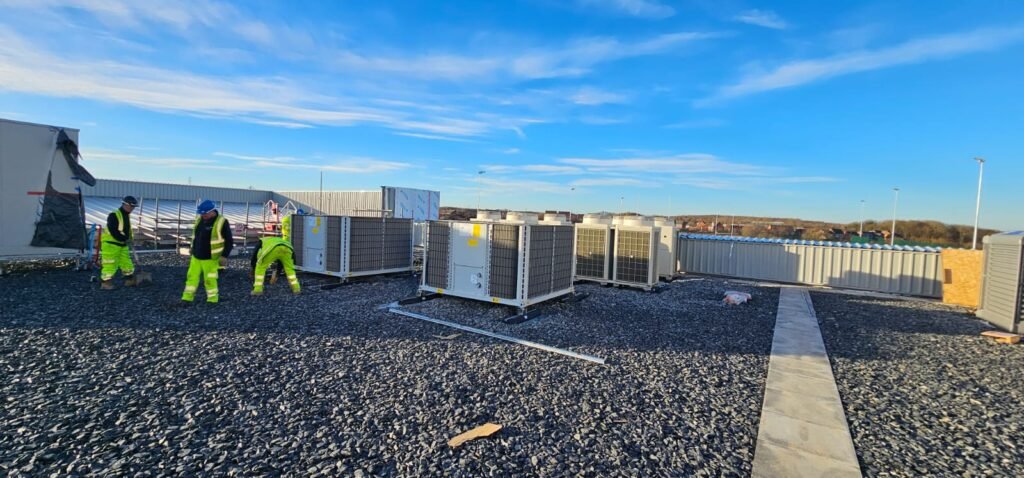
The unit lands on supports that are in place before the crane arrives. Swegon asks for its GOLD RX units to be mounted level on a flat, firm surface built to carry their weight. Daikin asks for a strong, level foundation with anti-vibration mounts under the frame, and says a chiller on a roof may need weight distribution beams. Check with the building owner that the roof or its steelwork has been designed for the unit’s weight before the lift date.
People on the roof and below
Whoever guides the unit onto its supports is working at height, and in Great Britain the Work at Height Regulations 2005 apply. HSE’s roof work guidance says a secure double guardrail and toeboard can prevent falls from a flat roof edge, and that a roof should be taken as fragile unless a competent person has confirmed otherwise.
Below the lift, HSE’s planning guidance says loads should not pass over occupied areas where that can be avoided, and that the area under a load left hanging for a significant time should be closed off as a danger zone.
Taking the old unit out
On a replacement, the old unit comes off first. The mechanical and electrical (M&E) contractor isolates it and drains it down. In Great Britain, an F gas (fluorinated gas) refrigerant has to be recovered by a technician qualified to work with F gas, under GOV.UK guidance on recovering F gas. Our plant room strip-out service takes out redundant air handling units and chillers.
Units going into a plantroom
A rooftop plantroom with a roof of its own limits where the crane can put the unit down. The crane lands it within reach, and the unit is moved the rest of the way into position on the plantroom floor, which is lift and shift work.
Example
A worked example: a made-up chiller swap
This is an invented job with round figures for illustration. An old air cooled chiller comes off a flat roof and a new one goes on in its place, with one mobile crane set up in the car park for both lifts. The new chiller’s supports are already fixed, a little closer to the roof edge than the old ones.
| Item | Old chiller (off) | New chiller (on) |
|---|---|---|
| Unit weight, from the maker or the nameplate | 2.6 t | 3.0 t |
| Spreader beam and slings | 0.3 t | 0.3 t |
| Crane’s hook block | 0.2 t | 0.2 t |
| Total the crane lifts | 3.1 t | 3.5 t |
| Radius at the furthest point | 26 m | 22 m |
The crane chosen needs at least 3.1 t of capacity at 26 m and at least 3.5 t at 22 m, and its boom has to reach over the parapet for both lifts. Because capacity falls as the radius grows, the lighter old chiller, sitting further back, can be the lift that fixes the size of crane needed.
On a real job the figures come from the unit’s maker and the chart for the crane that will be used.
From our lifts
We ask for the maker’s data sheet and lifting instructions, so we know the weight and how the unit has to be rigged. Then we look at the landing spot: are the supports or steelwork in place and level, and can the crane reach it over the parapet? We also check the route for the lorry delivering the unit.
The supports aren’t ready. The crane is set up with the unit on the hook, and the steel frame on the roof isn’t fixed or isn’t level. Next is a unit heavier than the paperwork said, because someone quoted the weight of a different model. Both stop the lift until the plan has been checked again.
Book the old unit out and the new one in on the same crane day. The crane is set up once and the road closure is applied for once. Send us both units’ weights and positions at the start, so the plan covers the heavier and further of the two.
Questions
Common questions
How do you get a chiller onto a roof?
A crane lifts it by the maker’s marked lifting points, rigged as the maker’s instructions say, and lands it on level supports fixed on the roof. The crane can be a mobile crane for the day, or the site’s tower crane on a new building if it has the capacity at the landing spot’s radius.
How much does a chiller weigh?
It depends on the model, so take the figure from its maker. Daikin points to the nameplate for the weight of its EWAD-T-B chillers, and Yanmar’s data sheet for six of its Y-VHA air cooled chillers lists shipping weights from 1,071 kg to 1,462 kg. The crane also lifts the rigging and its hook block.
How heavy is an air handling unit?
It varies with the unit’s size and the sections it comes in, so use the maker’s figures. Swegon’s instructions for its GOLD RX 70 and 80 give section weights, including about 800 to 1,070 kg for the filter and fan sections and about 300 to 425 kg for the rotor. Larger units can arrive in several sections.
Do you need permission to put a crane on the road?
Yes. In Great Britain a crane on or over the public road needs a permit from the road’s authority: the local council for most streets, or Transport for London on its red routes. A closure comes under the Road Traffic Regulation Act 1984. West Sussex County Council wants 7 working days’ notice, or 6 weeks with a closure.
Can the site’s tower crane lift the plant?
It can if its load chart shows enough capacity at the radius of the landing spot and it is still on site when the plant arrives. Like any crane, a tower crane can lift less the further out its load is, so a heavy unit at the far side of the roof may need a mobile crane.
Who removes the refrigerant before an old chiller is lifted?
In Great Britain, where the chiller holds an F gas refrigerant, a technician qualified to work with F gas must recover it, including at the end of the equipment’s life, under GOV.UK guidance. Isolating the chiller and draining it down sit with the M&E contractor, and the unit is rigged for lifting once that work is done.
Does a rooftop plant lift need a lift plan?
Yes. In Great Britain, regulation 8 of LOLER requires every lifting operation involving lifting equipment to be properly planned by a competent person. On a crane lift, BS 7121-1 gives that planning to the appointed person. Our guide What is a lift plan? sets out what the plan contains and who writes it.
What does it cost to crane a chiller onto a roof?
The price follows the crane the lift needs and how long it is on site. A road closure or out of hours working adds to it. Crane hire is priced by the day or the week. Send us the unit’s weight and a site plan for a same-day quote.
Get a quote
Get a quote for your plant lift
Call us on 0800 008 6096 or email office@synergy-lifting.co.uk. Send us the maker’s weights and lifting instructions for the unit, with photos or a site plan showing where it has to land and where a crane could stand, and we will plan the lift and quote for it.
Find out more about our crane hire and contract lifting service, or our plant room strip-out service for taking old units out first.
Related
Find out more
Get a quote
Ready for a quote?
Send us the details and we will come back with a quote, usually the same day for a desktop survey.
Or call 0800 008 6096