

Contents
Overview
Is there a crane wind speed limit?
There is no single crane wind speed limit that covers every lift. The crane’s maker sets a limit for each way the crane can be rigged, shown in its load charts and manual, and the lift plan works from that figure. The limit is lowered when the load catches more wind than the maker allowed for.
On the day, the reading that counts is the gust at the top of the crane, taken by the anemometer (wind gauge) on the boom where there is one, and checked against the limit in the lift plan. A forecast helps you choose the day, and the crane operator decides whether the lift goes ahead.
In short
- In Great Britain, HSE’s guidance on LOLER says the highest wind speed a piece of lifting equipment can work in should be given in its instructions where appropriate, with steps in place to measure the wind and reduce its effect.
- The limit for a lift is the lower of the crane maker’s figure and any limit set for the load or the lifting gear.
- A load with a large face for its weight, such as a cladding panel, can need a lower limit than the crane on its own.
- Under CPA guidance, anyone in the lifting team should be able to stop a lift in wind, and the crane operator has the final say.
Through our crane hire and contract lifting service you can hire a crane or have the whole lift done for you. On a contract lift, our own appointed person plans the lift and writes the lift plan.
Why it matters
How wind affects a crane and its load
Wind pushes sideways on the crane’s boom and on the load hanging below it, and that push grows fast as the wind picks up. The Construction Plant-hire Association (CPA) explains in its guidance on lifting operations in wind that the force follows the square of the wind speed, so if the wind speed doubles, the force on the crane and load is four times larger.
Loads that catch the wind
A compact machine and a cladding panel of the same weight behave very differently on the hook, because the panel gives the wind far more area to push on. HSE’s guidance in L113 says the shape of the load, and the way it is lifted, can increase the effects of the wind, which may affect the crane’s stability and rated capacity.
A load in the wind also turns until the push is even on each side of its centre of gravity, and it can swing past that point and back several times before it settles, the CPA notes. A gust can carry the load out from under the boom head to a different radius from the one in the plan. Radius is the horizontal distance from the centre of the crane’s slew ring to the load’s centre of gravity, as our guide What size crane do I need? defines it, and a larger radius leaves the crane less capacity. The crane’s rated capacity indicator, the system that warns the operator as the load nears the crane’s capacity, may then show a different radius from the real one.

Gusts
Wind is rarely steady. The Met Office defines a gust as the highest three-second average wind speed in a period, and the mean wind speed as the average over the ten minutes before a reading (how the Met Office measures wind). Gusts are short, but the CPA guidance says they are the forces that actually act on the crane and the load, so the decision to lift should be made on the gust.
Height
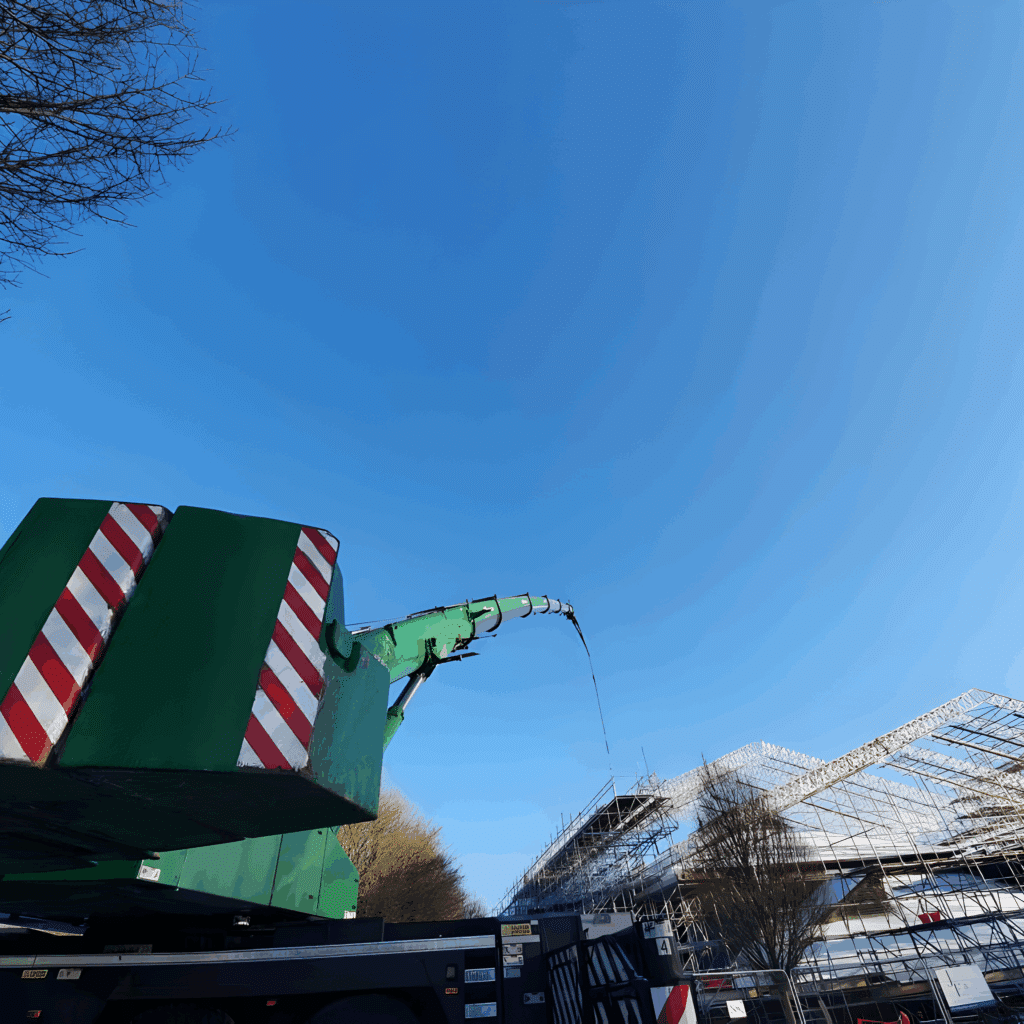
Wind speed normally increases with height above the ground, and buildings and trees slow it near the surface, the Met Office explains. A lift that starts in calm air at ground level can meet a stronger wind higher up, and the higher a load travels, the greater the overturning effect on the crane, according to the CPA.
The limit
Who sets the wind limit for a lift
In Great Britain, regulation 8 of LOLER requires every lifting operation involving lifting equipment to be properly planned by a competent person, and HSE lists the effects of wind among the points its LOLER guidance covers on planning lifting operations. In practice the wind limit for a crane lift is built up in stages.
It starts with the crane maker. Under BS EN 13000, the European standard for mobile cranes, the highest wind speed the crane may work in appears in its load charts and its manual, as our guide to BS EN 13000 explains. The CPA guidance adds that a longer boom typically has a lower working wind speed than a shorter one in the same configuration, and that the limit should come from the maker’s instructions for use, never from a sales brochure.
The maker’s figure assumes the load has a set amount of wind area for each tonne it weighs, and a load with more area than that needs its own check. The CPA guidance gives that check to the appointed person, the person in overall control of a crane lift under BS 7121-1, who lowers the wind limit for a load with a large face for its weight. BS 7121-3, the code of practice for mobile cranes, says the maker’s wind limit should never be exceeded, and that limits for rigging and de-rigging, setting the crane up and packing it away, can be lower than the limit for lifting.
Several wind limits can apply to the same crane and lift. This table shows where each one comes from:
| Limit | Who sets it | Where it is found |
|---|---|---|
| The crane’s working limit | The crane maker, for each configuration of boom and counterweight | The load charts and the manual |
| Rigging and de-rigging limit | The crane maker | The manual, and it can be lower than the working limit |
| A limit for the load | The appointed person, where the load has more wind area than the maker allowed for | The lift plan |
| A limit for the lifting gear | The maker of the gear, where it sets its own | The gear’s instructions |
| The operator’s judgement | The crane operator, whenever the crane or load is not behaving safely | On the day, from what the operator sees and feels |
The limit for the lift is then put in writing. Under BS 7121-1, the method statement, the step-by-step account of how the lift is done, records the highest wind speed at which the lift can go ahead, and the CPA guidance has the lift plan set out the crane’s limit along with any lower limits for the load or the lifting gear. Our guide What is a lift plan? covers the rest of the plan.
Measuring
How wind speed is measured on a crane
HSE’s guidance in L113 names an anemometer fixed to the lifting equipment as the commonest way to get an instant wind reading, and says it should sit in the most exposed position, at the top of the equipment as a rule. On a mobile crane that means the boom tip, and the CPA guidance notes that many mobile cranes already carry an anemometer there.
The operator sees the live reading in the cab. Apps and other devices fed from the anemometer can show a ten-minute mean with the peak gust in that period, so the CPA asks users to understand exactly which figure they are looking at.
Some lifting equipment has no anemometer of its own. Few lorry loaders carry one, so BS 7121-4 leaves the risk assessment to decide how the wind is measured, with a handheld anemometer or a reading taken on site, as our guide to BS 7121-4 explains.
Wind around buildings
A reading at one point says little about what the wind does between buildings. The CPA guidance warns that in built-up areas wind can be funnelled between buildings or deflected into swirling eddies. A site visit can help show where that happens, provided it takes place in weather like that expected on the day of the lift.
Forecasts
Using wind forecasts to plan a lift
A forecast is for choosing the day, and the crane’s anemometer is for the lift itself. HSE’s guidance in L113 says forecasting services give a general idea of the wind expected in an area from day to day, but cannot show the wind at a particular place at a particular moment. Read a forecast with these points in mind:
- Gusts: a Met Office forecast gives a mean wind speed for the time shown and a gust, the highest wind speed expected before the next period (what the Met Office forecast means). Plan on the gust.
- Height: the Met Office measures wind on a mast 10 m above the ground, and the CPA notes that forecasts are given for that height. A boom tip well above it can be in a stronger wind.
- Area: forecasts are worked out for the middle of a grid square about 10 km across, so they can miss local features and nearby buildings, according to the CPA.
- Record: the CPA guidance says any forecast used to make a decision should be recorded.
Where the forecast allows, the CPA suggests putting wind-sensitive lifts at the times of day, or in the periods, when the wind is expected to be lower. Our wind check tool shows the Met Office forecast for a site and lets you adjust the gusts to the height of the lift.
Stopping
When wind stops a lift and how the crane is made safe
HSE’s guidance in L113 suggests setting wind action levels: the wind speeds at which extra measures are taken to keep the equipment stable. Depending on the equipment, those measures range from lowering the load and waiting for the wind to drop to taking the equipment down and leaving it in a safe condition. Taken together, the CPA guidance and L113 give these steps as the wind rises:
- The crane supervisor and site management watch the forecast, and the operator watches the anemometer, so the team knows when the wind is nearing the limit.
- Taglines, the ropes used to steady a load, are for guiding it into position and between obstructions. The CPA says they are not to be used to wrestle with the wind.
- When the gust reaches the lowest limit that applies, or the operator judges the lift unsafe, lifting stops and the load is landed safely, on the ground where it can be.
- Before the crane is left, it goes into the out-of-service configuration, the safe parked set-up its maker’s manual gives. The boom or jib may need to be folded away or laid down, and all lifting accessories come off the hook.
Under the CPA guidance, any member of the lifting team should have the authority to stop a lift, and the final decision rests with the crane operator, who can see and feel how the crane and load are responding. HSE’s guidance on lifting operations in construction also gives the crane supervisor the authority to stop a lift judged dangerous. The CPA asks site management to accept the lifting team’s decision, and leaves it to the operator to decide when lifting can start again.
Thunder is a separate reason to stop. BS 7121-3 says work should stop when a thunderstorm approaches, and a crane struck by lightning needs a thorough examination before it is used again.
From our lifts
We look at the forecast gusts for the lift day, not the mean wind, and we check them at the height the boom will reach. We ask for the size of the load’s largest face as well as its weight, so the appointed person can see whether it needs a lower limit than the crane. That limit goes in the lift plan.
The wind at ground level feels fine and the gust at the boom tip is over the limit. The other one is a load that looked compact on the drawing but arrives as a big flat panel or crated unit. In both cases the lift waits, and the appointed person checks the limit again before anything leaves the ground.
Book a wind-sensitive lift with a second date agreed at the start, and check the forecast again two days before. Send us the load’s dimensions with its weight, not just the weight. If the forecast turns, tell us early, so the crane and any road closure can move to the second date together.
Questions
Common questions
What is the maximum wind speed a mobile crane can work in?
It depends on the crane and how it is rigged, so there is no single figure. The maker sets the highest wind speed for each configuration in the load charts and manual, and a longer boom can have a lower limit. The appointed person can set a lower limit again for a load that catches the wind.
At what wind speed do cranes stop lifting?
A crane stops lifting when the gust at the boom tip reaches the limit in the lift plan. That limit is the crane maker’s figure, brought down where the load or the lifting gear needs a lower one. Under CPA guidance the operator can also stop sooner if the lift looks unsafe, and the operator’s decision is final.
Can the wind move a crane?
Yes. Wind adds an overturning effect on the crane, and the CPA says that effect grows the higher the load is lifted. A gust can also blow the load to a different radius from the one planned. Out of service, the crane is parked as its maker’s manual sets out.
Does wind reduce what a crane can lift?
It can. In Great Britain, HSE’s guidance in L113 warns that a load’s shape and the way it is lifted could add to the wind’s effects, which may affect the crane’s stability and rated capacity. Under CPA guidance, the appointed person sets a lower wind limit for a load with a large face for its weight.
Is the wind stronger at the top of a crane?
Yes. The Met Office explains that wind speed normally increases with height, and its stations measure the wind 10 m above the ground. Forecasts are given for that height too, the CPA notes, so the boom head of a tall crane may meet more wind than forecast. The lift works to the reading from the crane’s own anemometer.
Who decides to stop a crane lift because of wind?
The crane operator has the final say under CPA guidance, and any member of the lifting team should be able to stop the lift. In Great Britain, HSE’s construction guidance says the crane supervisor should have the power to halt a lift that has become dangerous. Before the day, the appointed person sets the wind limit in the lift plan.
Can you rely on a weather forecast for a crane lift?
Use it to plan, then check on the day. HSE’s guidance in L113 treats a forecast as a broad guide to an area’s wind from day to day, and says it cannot pin down the wind at one spot at one moment. On the day, the lift works to the crane’s own anemometer at the top of the boom.
Why do large panels need a lower wind limit?
A crane maker’s wind limit assumes a set wind area for the load’s weight. A cladding panel or a site cabin has far more area for its weight, so the wind pushes harder on it. Under CPA guidance, the appointed person checks the load against the maker’s allowance and lowers the wind limit where the load exceeds it.
Get help
Get help planning a lift around the wind
Call us on 0800 008 6096 or email office@synergy-lifting.co.uk. Send us the load’s weight, the size of its largest face, how high it has to go and the site postcode, and we will quote for the crane or for the whole lift.
Find out more about our crane hire and contract lifting service, or our steel erection and dismantling service for lifting steelwork into place.
Related
Find out more
Get a quote
Ready for a quote?
Send us the details and we will come back with a quote, usually the same day for a desktop survey.
Or call 0800 008 6096