

Contents
Overview
The main difference between a spreader beam and a lifting beam
Spreader beam vs lifting beam comes down to how each takes the load. A spreader beam hangs from two angled top slings and is squeezed along its length, so it is lighter for the same load but needs more headroom. A lifting beam hangs from a lug under the hook and bends, so it weighs more but needs little headroom.
Both sit between the crane hook and the slings on the load. A lifting beam works like a plank held up in the middle with a weight at each end, while a spreader beam is more like a prop pushed from both ends.
In short
- A spreader beam is rigged with a top and a bottom sling at each end. A lifting beam can carry a row of bottom slings under it.
- In Great Britain, both are lifting accessories under LOLER, so they must be marked and thoroughly examined regularly.
- The beam’s own weight, and that of all the rigging, counts towards what the crane has to lift.
On a contract lift, our own appointed person plans the lift and writes the lift plan.
Sources
Where the guidance on beams comes from
How the beams carry a load is described in LEEA’s code of practice. The legal duties come from LOLER in Great Britain and HSE’s guidance on it, L113. Where the page explains headroom or protecting the load, that is our own explanation. Some limits are set by each maker and can differ between beams: the rating at each span, and how far the bottom slings may lean from vertical. The one maker figure on this page carries the maker’s name. Work to the rating plate and instructions for your own beam, and have the lift planned by a competent person, as LOLER requires. On a crane lift, BS 7121-1 calls this person the appointed person.
How they work
How each beam carries the load
Spreader beams
A spreader beam has a top lifting point at each end and a load point at each end underneath. Because the top slings meet at the hook, they pull the ends inward as well as up, and the beam resists by being pushed together along its length. LEEA’s code treats it as a strut: at each end, the centre lines of the top sling and the bottom sling should meet on the beam’s centre line, its neutral axis, so the beam is only squeezed. Its own weight and any offset in the rigging still bend it a little.
Limits on spreader beam rigging
Modulift warns that adding slings along the span of its spreader beams can make them fail. It also allows the bottom slings on its beams no more than 6 degrees from vertical, with a longer beam needed beyond that.
Lifting beams
A lifting beam hangs straight from the hook by a lug on its top, with the load hung from bottom slings along its underside. Because the load hangs from points away from where the beam is held, the beam bends, so it has to be deeper and stiffer, and it weighs more than a spreader beam of the same rating.

Choosing
When each type of beam suits the lift
Headroom
Headroom is the height from the hook at its highest to the top of the load once it is lifted clear. A spreader beam needs room for its top slings as well as everything below them, so it is a poor fit where headroom is limited. A lifting beam hangs close under the hook, needing little more than its own depth above the bottom slings, so it often suits lifts inside a building or under an overhead travelling crane.
Protecting the load
Two slings running from one hook straight to the ends of a long load lean inward, and they can crush the load or damage its edges. With a beam above, the bottom slings hang close to vertical, which avoids that kind of damage.
Long or flexible loads
A long load can sag between two points, so it may need support at more of them. A lifting beam can carry several bottom slings along its underside. Spreaders can also be combined with each other or with a lifting beam.
The two beams side by side
| Point | Spreader beam | Lifting beam |
|---|---|---|
| How it hangs from the hook | From two top slings running up from its ends | From a lug on its top, directly below the hook |
| How the beam takes the load | Mainly compression, as a strut | Bending |
| Bottom slings | One at each end | Two or more along its underside |
| Headroom needed | More, to fit the top slings | Little more than the beam’s own depth |
| Own weight for the same rating | Lighter | Heavier, as it must be deeper and stiffer |
| Suits | Long or wide loads where there is height to spare | Low headroom, and loads that need several pick points |
Types
Fixed, adjustable, telescopic and modular beams
Spreader beams come in four main forms. Lifting beams come in fixed and adjustable forms, and some are modular. Any beam that is not fixed can be set up for loads of different lengths.
- Fixed: a set length with lifting points that do not move.
- Adjustable: lifting points that move along the beam to suit loads of different sizes. On a lifting beam these are lugs set at several positions.
- Telescopic: a spreader beam that extends or retracts to change its length.
- Modular: a beam built from parts bolted together. In a modular spreader beam, struts go between two end units, with a drop link (a short link hanging from the end unit) at each end for the bottom sling, and struts are added or taken out to change the span.
A modular beam’s rating changes with its span, so build it only from parts the maker supplies for that model and check the rating for the span you have assembled.
The law
Lifting beams and spreader beams under LOLER
The Lifting Operations and Lifting Equipment Regulations 1998 (LOLER) apply to lifting beams and spreaders in Great Britain as lifting accessories, the gear between the lifting machine and the load. HSE’s guidance, L113, lists them as examples, and our guide to LOLER covers the rest of the regulations. In Northern Ireland, the Lifting Operations and Lifting Equipment Regulations (Northern Ireland) 1999 apply instead.
Marking
Under regulation 7, an accessory must be clearly marked with its safe working load and anything else needed to use it safely. The difference between SWL and WLL is explained in our guide. L113 adds that where an accessory’s weight is significant compared with the safe working load of the machine it is used with, it should be marked with its weight.
Thorough examination
Under regulation 9, a beam exposed to conditions that could make it deteriorate and lead to danger needs a thorough examination by a competent person at least every 6 months, or at the intervals in an examination scheme (a written schedule drawn up for that item by a competent person). It also needs one after any exceptional event that could affect its safety, such as damage.
Product standard
BS EN 13155 is a European standard for non-fixed load lifting attachments, lifting beams among them. It is explained, with the checks to make before use, in our lifting accessory standards guide.
Adding the beam’s weight to the load
L113 names mobile crane lifts as one case where the lifting accessories, the hook block included, should count towards the load. Add the beam and all the rigging to the load’s own weight before checking the crane’s capacity. How that total sets the size of crane is covered in What size crane do I need?
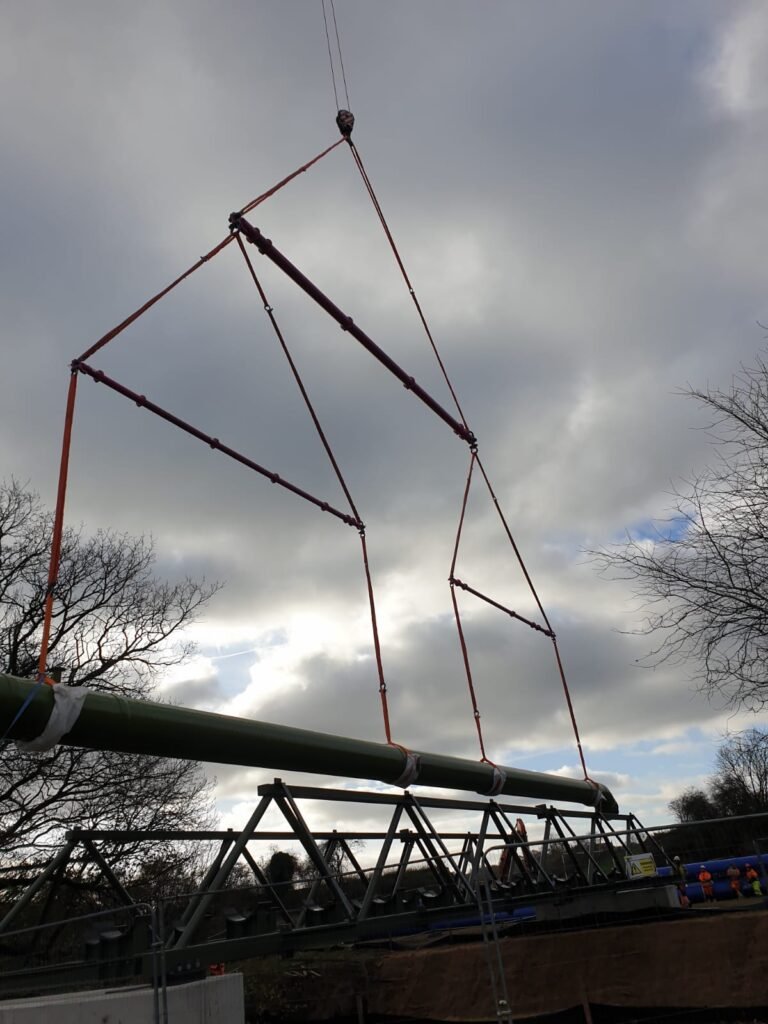
From our lifts
We ask for the load’s weight, its lifting points and the height available below the hook. A spreader beam needs room for its top slings, so headroom usually decides it.
Before a beam goes on the hook, we check the rating plate and that the beam’s own weight is in the lift plan. On modular beams and frames we also check the nuts, bolts and washers, and that bolts are tightened to the maker’s torque setting. We check there’s no debris between components, that the components are in the right order, and that the number of struts is within the maker’s limit.
Questions
Common questions
What is a spreader beam used for?
A spreader beam is used to hold a load’s slings apart so they hang close to vertical. That lets a crane pick a long or wide load at two points far apart without the slings pulling inward and crushing it. The beam takes that inward pull itself, as a strut in compression.
What are lifting beams used for?
Lifting beams are used where headroom is low, such as inside a building, and for loads that need more than two pick points. A lifting beam can have several load attachment points along its length. Some have lugs at several positions, so the pick points can be moved to suit the load.
What are the types of spreader beam?
Spreader beams are made in four forms: fixed, adjustable, telescopic and modular. A fixed beam has one set length, and the other three can be changed to suit the load. For a modular beam, check the maker’s rating for the span you build it to. The types section above describes each one.
What are the alternatives to using a spreader beam?
The main alternatives are a lifting beam, which needs less headroom, and a lifting frame, which picks the load at four points. If the load has suitable lifting points and will not be crushed, a multi-leg sling from the hook may do, within LEEA’s leg angle limits. Our sling angles guide shows how the angle adds to each leg’s pull.
Is a lifting frame the same as a spreader beam?
No. A lifting frame is, in effect, a combination of four spreaders, so it holds the bottom slings apart in both directions, along the load and across it. It suits a load picked at four corners, where a single spreader beam would only spread the slings one way.
Can a lifting beam be used with two cranes?
Yes, where the beam is built for it. A lifting beam can have suspension points for two or more crane hooks. Use one only where its marking and the maker’s instructions allow it, and treat the job as a two-crane lift, planned and set out in its own lift plan.
How is a spreader beam designed?
A spreader beam is designed to be strong and stable enough for every load it lifts. In Great Britain, LOLER regulation 4 makes that a duty, and regulation 7 requires its safe working load to be marked. BS EN 13155 sets safety requirements, including proofs of strength and stability, for lifting beams, the generic term LEEA’s code uses for spreaders too.
What are the common failures of spreader beams?
The causes to guard against are overloading and misuse: lifting more than the marked safe working load, altering the beam, adding slings along the span or letting the bottom slings lean further than the maker allows. Give the beam a pre-use check for obvious damage before each lift.
Get help
Planning a lift with a beam
Call us on 0800 008 6096 or email office@synergy-lifting.co.uk. Give us the load’s weight with its length and width, and send photos of the load and the headroom above it. We will advise on which type of beam suits the load, and what length.
Lifts by crane come under crane hire and contract lifting, and loads moved within a building under lift and shift.
Related
Find out more
Get a quote
Ready for a quote?
Send us the details and we will come back with a quote, usually the same day for a desktop survey.
Or call 0800 008 6096