
Contents
Overview
What a tower crane is
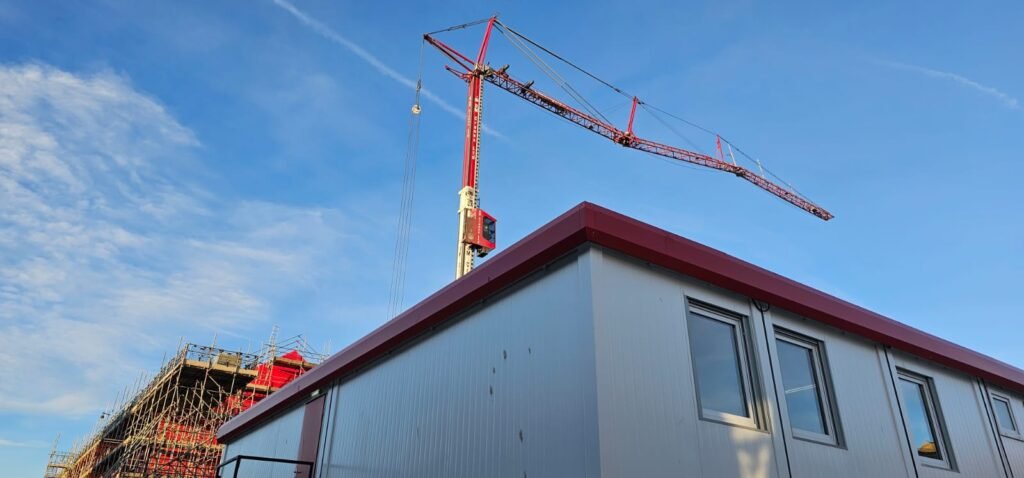
A tower crane is a fixed crane built up from a tall lattice tower, with a jib at the top that slews to lift materials and components across a building site. It stays in one place for the length of a project, and there are three main types: flat top, luffing jib and self-erecting. They differ in how the jib moves, how much space they need around them and how they get onto site.
In short
- A tower crane is a fixed crane on a lattice tower, used for repeated lifting on one site for weeks or months.
- Flat top: a fixed horizontal jib with the load on a trolley. The most common type on open sites.
- Luffing jib: the jib raises and lowers to change reach, so it can work on tight sites without swinging over neighbours.
- Self-erecting: a smaller crane that unfolds itself on site, suited to low-rise and shorter jobs.
- Every tower crane needs a designed base, a planned erection and dismantle, and thorough examination before use.
We supply all three types for crane hire and contract lifting, with operators, erection and dismantling, and lift planning and supervision. Well-known makes include Liebherr, Potain, Terex, Comansa and Wolff.
How it works
How a tower crane works
Every tower crane has a vertical lattice tower, a slewing jib at the top and a counterjib carrying the counterweight. How it stands, how it is put up and how it is driven are broadly the same across the three types of tower crane.
How it stands
Most tower cranes stand on a concrete foundation cast for the purpose, or on a base frame held down with ballast. Taller cranes may be tied into the building as it rises. The base is designed by an engineer for the crane, its configuration and the ground it sits on.
How it is erected
Except for self-erecting models, a tower crane arrives in sections on lorries and is built by a specialist erection crew, usually with a mobile crane to lift the sections into place. It is dismantled the same way at the end of the job.
How it is controlled
Larger tower cranes are driven from a cab at the top of the tower, giving the operator a view over the site. Smaller cranes, including most self-erectors, are often operated by remote control from the ground.
Type
Flat top tower cranes
A flat top tower crane has a horizontal jib fixed at the top of the tower, with the load carried on a trolley that runs in and out along the jib. The jib has no tower head or tie bars above it, which is where the name comes from.
How it works
The crane changes radius by moving the trolley, and covers the site by slewing the whole jib round. With the jib always horizontal, the area it sweeps is a full circle at the jib’s length.
Where it fits
Flat tops suit open sites where the jib can swing freely, such as housing, commercial and industrial builds. With nothing above the jib, they can be set up with less height between cranes on sites that need more than one, and are simpler to erect than older hammerhead designs with a tower head.
Trade-offs
Because the jib cannot be raised, it sweeps its full length whenever it slews. On tight sites that means oversailing neighbouring land, roads or railways, which needs permission and may not be possible.
Type
Luffing jib tower cranes
A luffing jib tower crane changes its reach by raising and lowering the jib, rather than moving a trolley along it. The load hangs from the jib tip.
How it works
With the jib raised, the crane’s working radius and its slewing footprint both shrink. It can swing round within the site boundary, clear of neighbouring buildings and other cranes, and lower the jib only where it needs to reach.
Where it fits
Luffers are the usual choice on congested city sites, next to railways and roads, on high-rise builds and where several cranes work close together. They also tend to carry heavier loads than a flat top of similar size.
Trade-offs
Luffing cranes are more complex to erect and operate, and they need careful management in high winds. The HSE has published guidance on preventing failure of luffing jib tower cranes in high winds, and the manufacturer’s out-of-service jib position must be followed.

Type
Self-erecting tower cranes
A self-erecting tower crane is a smaller tower crane that folds up for transport and unfolds itself on site, without an erection crew building it section by section.
How it works
The crane arrives folded, usually on its own axles or on a lorry, sets up on outriggers or a base with ballast, and raises its tower and jib with its own mechanism. It is normally operated by remote control from the ground.
Where it fits
Self-erectors suit low-rise housing, extensions, small commercial builds and shorter projects where a full tower crane would be too much. They take up little space and can often be set up in a day.
Trade-offs
They are smaller than the other types, with less height, reach and capacity. For taller buildings and heavier loads, a flat top or luffing crane is needed. For very short jobs, a mobile tower crane can give similar reach without a base at all.
Planning
What to plan for with a tower crane
A tower crane is on site for weeks or months, so the planning starts well before it arrives.
The base and ground
The foundation or base is designed for the crane and the ground conditions, which usually means a site investigation first. The base has to be in place, and a concrete foundation cured, before erection can start.
Erection and dismantling
Erection needs access and space for the lorries and the assist crane, an exclusion zone and sometimes a road closure. The same applies at the end of the job, when the building may be in the way, so the dismantle is planned from the start.
Oversailing and neighbours
If the jib will swing over neighbouring land, a public road or a railway, permission is needed from the owner or authority. This is often what decides between a flat top and a luffing crane.
Aviation
Cranes near aerodromes, and very tall cranes anywhere, may need to be notified. The Civil Aviation Authority’s crane notification guidance sets out when and how.
Power lines and wind
Overhead power lines near the jib’s path are planned around using the HSE’s guidance on avoiding danger from overhead power lines. Wind limits for working and the out-of-service arrangements follow the manufacturer’s instructions, and are checked throughout the job.
Thorough examination
Under regulation 9 of LOLER, a tower crane must be thoroughly examined after it is installed and before it is used at each new site, then at regular intervals while it is in use.
Hiring
Hiring a tower crane
We supply flat top, luffing and self-erecting tower cranes with trained, carded operators, and we arrange the erection and dismantling. We can also provide the lift planning and supervision for the project.
Lift planning and supervision
Regulation 8 of the Lifting Operations and Lifting Equipment Regulations 1998 (LOLER) requires every lifting operation to be properly planned by a competent person, appropriately supervised and carried out in a safe manner. The HSE’s LOLER guidance explains what that means in practice, and the BS 7121 codes of practice, including the part for tower cranes, set out how the appointed person and crane supervisor roles work.
What we need to know
- The heaviest loads and the furthest radius they need to reach
- A site plan showing where the crane could stand and what surrounds the site
- The height of the building and how long the crane is needed
- Any known ground conditions, and whether a site investigation has been done
Our guide to crane hire or a contract lift explains who is responsible for what under each arrangement.
Questions
Common questions
What are the main types of tower crane?
The three main types are flat top, luffing jib and self-erecting. Flat tops have a fixed horizontal jib and a trolley, luffers raise and lower the jib to change reach, and self-erectors are smaller cranes that unfold themselves on site.
What is the difference between a luffing and a flat top tower crane?
A flat top keeps its jib horizontal and moves the load on a trolley, so it sweeps its full jib length as it slews. A luffing crane raises its jib to reduce its footprint, which lets it work on tight sites without swinging over neighbours.
What is a self-erecting tower crane?
A smaller tower crane that folds for transport and unfolds itself on site without a separate erection crew. It suits low-rise building and shorter projects.
Does a tower crane need to be examined before use?
Yes. LOLER requires a thorough examination after installation and before first use at each site, and then at regular intervals while the crane is in use.
Do I need to tell anyone about a tower crane?
Often. Oversailing neighbouring land or a road needs permission, and cranes near aerodromes or over a certain height need to be notified under the Civil Aviation Authority’s crane notification process.
Get a quote
Get a quote for tower crane hire
Call us on 0800 008 6096 or email office@synergy-lifting.co.uk. Send us a site plan, the heaviest loads and how long you need the crane, and we will recommend the right type.
Find out more about our crane hire and contract lifting, steel erection and dismantling and traffic management and road closures services.
Related
Find out more
Get a quote
Ready for a quote?
Send us the details and we will come back with a quote, usually the same day for a desktop survey.
Or call 0800 008 6096