Contents
Overview
What is a mobile tower crane?
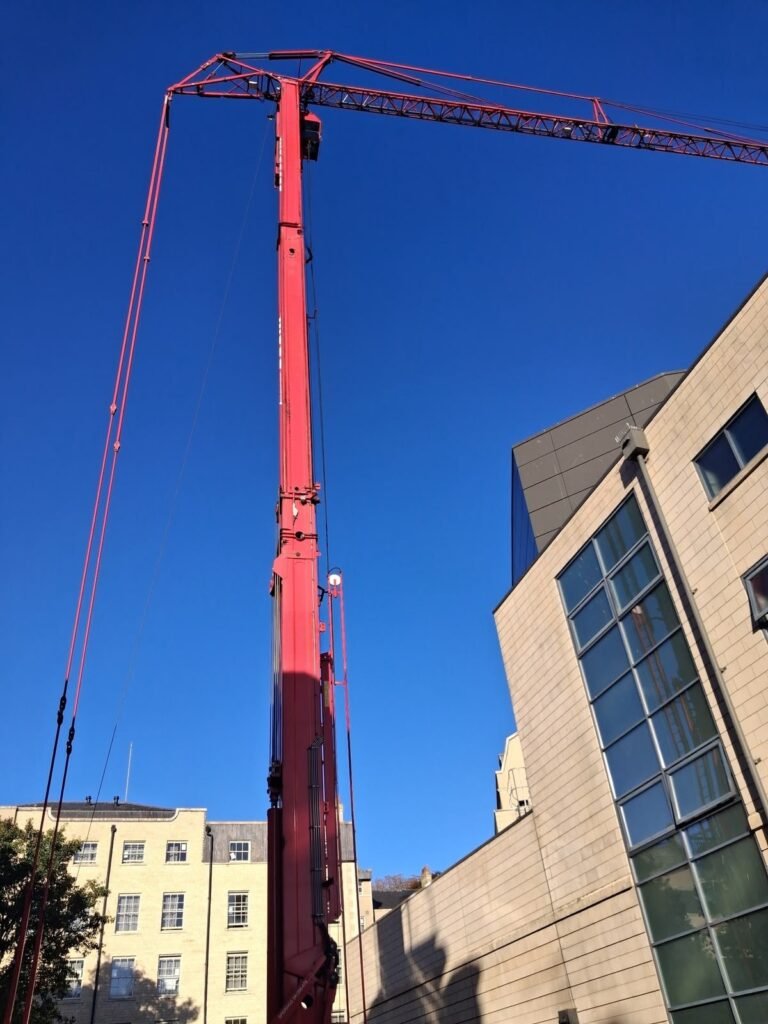
A mobile tower crane is a tower crane built into its own road-going carrier. It drives to site and sets up its tower and jib without an assist crane. It then lifts like a tower crane, running the load along a jib of up to 65 m to reach well over a building from a small patch of ground.
In short
- Pick one for long reach with light loads: the jib tip takes around 2 t on most models.
- It needs no base, so there is nothing to build before it lifts or to break out after it leaves.
- Electric models lift on the site supply, which helps on occupied sites and at night.
- Check the ground and what the jib swings over well before the lift day.
We supply mobile tower cranes from makers including Spierings and Liebherr for crane hire and contract lifting.
How it works
How a mobile tower crane works
Once it is set up, a mobile tower crane lifts the way a static tower crane does, from a trolley on a horizontal or raised jib.
Tower and jib folded on the carrier
The tower and jib fold down onto a multi-axle carrier for the road, with three to six axles across the models in the table below. On site the crane stands on its outriggers and sets itself up hydraulically. Spierings says its mobile tower cranes need no assist crane and no loose ballast, and lists its 7 t and 10 t models as ready to lift in 8 to 15 minutes.
Lifting from a trolley on the jib
The load hangs from a trolley that runs in and out along the jib. Because the tower stands upright, the crane can set up close to a building and place loads well back across the roof or the site behind.
Raising the jib for height
The jib can be raised when a job needs height more than reach. Liebherr lists luffed jib positions in steps up to 45° for its MK mobile construction cranes, and 70° for the MK 140.
Electric lifting from the site supply
Liebherr says its cranes produce neither exhaust fumes nor noise when they run on power from the site, so they can work in sensitive areas and at night. Where site power is limited, Liebherr offers a diesel generator or a battery storage unit to run the crane.
Handled by one person
Liebherr states that one person can handle its mobile construction cranes from transport through to operation.
Sizes
Mobile tower crane sizes and capacity
Mobile tower cranes are chosen for reach. The headline capacity applies only close to the tower, and the figure that matters is what the crane can lift at the radius of each load.
The table shows five current models from Spierings and Liebherr, with each maker’s published figures. Our crane library lists the mobile tower cranes we supply, with spec sheets and load charts.
| Crane | Max load | Max radius | Load at max radius |
|---|---|---|---|
| Liebherr MK 73-3.1E | 6 t | 38.5 m | 2 t |
| Spierings SK597-AT4 | 7 t | 48 m | 1.7 t |
| Liebherr MK 88-4.1E | 8 t | 45 m | 2.2 t |
| Liebherr MK 140-5.1E | 8 t | 65 m | 1.9 t |
| Spierings SK1265-AT6 | 10 t | 60 m | 1.7 t |
The figures are each maker’s headline data for the crane’s strongest set-up: full outrigger base and, where the maker offers it, extra ballast. A narrower base or less ballast carries less, so the lift plan works from the chart for the set-up the crane will stand in.
Jib length
In the table, the maximum radius runs from 38.5 m on the Liebherr MK 73-3.1E to 65 m on the MK 140-5.1E. A longer jib places a load further from the crane and carries less at its tip. Spierings shows the effect on the SK2400-R, a model on tracks that travels to site on two trailers: 5.5 t at the tip of its 42 m jib, and 2.5 t at the tip of the optional 50 m jib.
Capacity along the jib
Maximum loads run from 6 t on Liebherr’s MK 73-3.1E to 18 t on the Spierings SK2400-R in the two makers’ current ranges, each available only near the tower. The lift plan checks every load against the load chart at the radius where it is picked up and set down, and What size crane do I need? explains how radius is measured.
Hook height
Raising the jib lifts the hook well above the tower. Spierings gives the SK1265 a height under the jib of 40.5 m and a maximum lifting height of 64.2 m with the jib at 30°. Liebherr quotes a maximum hook height of 94.4 m for the MK 140.
A single heavy lift near the crane’s position is often better done with a telescopic mobile crane, such as an all-terrain crane.
Compared
Mobile tower cranes compared with other cranes
A mobile tower crane sits between a telescopic mobile crane and a static tower crane. It also differs from a self-erecting tower crane in how it gets to site.
Against a telescopic mobile crane
A telescopic mobile crane lifts from an angled boom, so reaching deep over a building takes a long boom at a shallow angle and a much bigger crane. A mobile tower crane stands close to the building with its tower upright and covers the same reach with a smaller machine. Our guide to city cranes covers a compact telescopic option.
Against a static tower crane
A static tower crane is built up on a base or foundation, usually with a mobile crane lifting the sections into place, and stays for the length of a build. A mobile tower crane needs no base and erects itself, so it fits jobs measured in days or weeks, or a project that needs a tower crane’s reach for a few phases only. Our guide What is a tower crane? describes the static types.
Against a self-erecting tower crane
A self-erecting tower crane also unfolds itself, but it arrives folded on its own towed axles or on a lorry, and sets up on outriggers or a base with ballast. A mobile tower crane travels as one road vehicle, so it drives in ready to work and leaves the same way.
Uses
Where mobile tower cranes are used
A mobile tower crane is the choice where loads travel a long way over a building or site and there is no room or time for a static tower crane.
- Roof work: lifting plant and roof sections over a building to the far side of the roof.
- Short building phases: extensions and infill plots where a static tower crane is not worth erecting.
- Steel and frame erection: placing lighter steelwork and cladding panels across a structure, as part of steel erection and dismantling.
- Town centre and occupied sites: the crane stands in one corner and reaches across the site, and an electric model keeps noise down.
- Many lifts in a day: the trolley places each load precisely along the jib, so a run of similar lifts goes quickly.
Planning
What to plan for with a mobile tower crane
Planning a mobile tower crane lift centres on where the crane stands and what its jib swings over.
Set-up position and ground
The crane needs a level, firm position for its outriggers and room to unfold the tower and jib. On a contract lift we send the outrigger loads with ground bearing pressure calculations for the mats, and the site’s own competent person confirms the ground is suitable. Our guides to outrigger mats and crane site preparation go into the detail.
Oversailing roads and neighbours
A long jib can swing over a road or a neighbouring property. In England and Wales, highway authorities usually treat a jib over a road as needing their consent under section 178 of the Highways Act 1980, which covers apparatus placed over a highway, and issue it as an oversail licence. In Scotland, roads authorities use section 90 of the Roads (Scotland) Act 1984 in the same way. Apply early, and agree any oversail of private property with the owner before the crane arrives.
Overhead power lines
A long jib on a busy site can come close to overhead lines. The HSE guidance note GS6, Avoiding danger from overhead power lines, is aimed at those supervising or in control of work near them, and the lift plan sets how close the crane may work.
Wind and the power supply
Wind limits depend on the crane, its jib set-up and the load, so the lift plan sets them and they are checked on the day. Our guide to crane wind speed limits explains who sets them. An electric crane also needs its site supply confirmed before it arrives.
The lift plan and the standards
In Great Britain, regulation 8 of the Lifting Operations and Lifting Equipment Regulations 1998 (LOLER) requires employers to make sure every lifting operation is properly planned by a competent person, appropriately supervised and carried out in a safe manner. The code of practice for mobile cranes, BS 7121-3, includes the mobile self-erecting tower crane among its crane types, and BS 7121-5 covers other tower cranes.
Hiring
Hiring a mobile tower crane
Each mobile tower crane we supply comes with a CPCS or NPORS carded operator, and the lifts we plan follow BS 7121.
Crane hire or contract lift
On crane hire you take the crane and operator, then plan and supervise the lifts yourself. On a contract lift we plan the job in house, through our appointed person, and carry it out. Crane hire or contract lift: what is the difference? sets out who is responsible for what.
What we need to know
- The heaviest load, and the furthest radius it has to be lifted at
- Where the crane can stand, and a site plan or drawing if you have one
- What the jib will swing over, including neighbouring property and roads
- How long you need the crane and how many lifts a day
Questions
Common questions
How far can a mobile tower crane reach?
A mobile tower crane reaches as far as its jib. Liebherr’s current MK range runs from 38.5 m on the MK 73-3.1E to 65 m on the MK 140-5.1E, and Spierings gives its SK1265-AT6 a 60 m jib. The load it can carry falls towards the tip, so the furthest load sets the crane and jib length.
How much can a mobile tower crane lift?
Across the current Spierings and Liebherr ranges, maximum loads run from 6 t on the Liebherr MK 73-3.1E to 18 t on the tracked Spierings SK2400-R, but only close to the tower. Out at the jib tip, the five wheeled models in our table carry between 1.7 t and 2.2 t in their strongest set-up, and less on a narrower outrigger base.
How long does a mobile tower crane take to set up?
Spierings lists 8 to 15 minutes to set up its 7 t and 10 t mobile tower cranes once they are in position. Its largest current model, the 18 t SK2400-R, takes 60 minutes. Allow time before that for preparing the ground and arranging consent for any oversail of a road.
What is the difference between a mobile tower crane and a tower crane?
A tower crane is built on a base or foundation and stays on site for the length of a project, and erecting it usually takes a mobile crane. A mobile tower crane arrives on its own road carrier and raises its own tower and jib, then drives away when the lifts are done.
Is a mobile tower crane the same as a self-erecting tower crane?
They are close relatives. A self-erecting tower crane is towed in on its own axles or carried on a lorry, then set up on outriggers or a ballasted base. A mobile tower crane is part of its own road carrier, and Spierings says its models need no loose ballast. The code BS 7121-3 covers this type as a mobile crane.
Can a mobile tower crane run on electricity?
Yes. Spierings and Liebherr both build mobile tower cranes that lift on power from the site, and Spierings quotes a 16 A or 32 A supply for its electric models. Running on site power cuts exhaust fumes and engine noise on occupied sites. Confirm the supply with the site before the crane is booked.
Do I need a lift plan for a mobile tower crane?
Yes. In Great Britain, LOLER regulation 8 requires the employer to make sure every lifting operation is properly planned by a competent person, appropriately supervised and carried out in a safe manner. On a contract lift, our appointed person writes the plan. On crane hire, the hirer plans and supervises the lifts.
Get a quote
Get a quote for mobile tower crane hire
Call us on 0800 008 6096 or email office@synergy-lifting.co.uk. Send the heaviest load with its furthest radius and a plan of where the crane can stand, and we will come back with the crane and jib that fit.
Our crane hire and contract lifting page covers both ways of working. Mobile tower cranes also lift on steel erection and dismantling and lift and shift work.
Related
Find out more
Get a quote
Ready for a quote?
Send us the details and we will come back with a quote, usually the same day for a desktop survey.
Or call 0800 008 6096