

Contents
Overview
How are tower cranes erected and taken down?
How are tower cranes erected? From parts, on a base built for the crane. A mobile crane, or sometimes a second tower crane, lifts the mast sections onto the base, then the slewing unit and cab. The rest of the top follows, with the jib and the counterweight fitted in the exact sequence the crane maker sets. The crane is tested and thoroughly examined before use.
This guide covers tower cranes built from parts. Mobile tower cranes and self-erecting tower cranes are different: they arrive folded and unfold themselves on site, as our guide What is a tower crane? explains.
In short
- The base counts as temporary works, the structures put in only to support the building work. An engineer designs it from the loads the crane supplier gives, and it is checked independently before the crane goes up.
- In Great Britain, LOLER requires a crane whose safety depends on its installation to be thoroughly examined at each new site before it goes into service.
- A tall crane can raise itself by climbing, adding mast sections with its own hydraulic frame.
- Under CPA guidance, the crane supplier is usually contracted to put the tower crane up and take it down. The lifts in between are planned by the site’s appointed person on crane hire, or by the lifting contractor’s appointed person on a contract lift.
The cranes we supply are listed on our crane hire and contract lifting service page.
Who does it
Who erects a tower crane
The erection is usually done by a specialist team from the crane supplier, led by an erection supervisor. BS 7121-5, the British Standard code of practice for tower cranes, expects that supervisor to be an experienced senior erector who runs the team and answers for its work. The CPA’s note on erection teams (TIN 030) sets a minimum of four people: a supervisor, a senior erector, an erector and a technician.
Putting up a tower crane is planned like a lift. Under BS 7121-5, the appointed person (the planning role set out in BS 7121-1) has the risks assessed and approves a method statement for the erection, the step-by-step account of how the work will be done. The standard calls for a plan for erection and dismantling separate from the plan for the crane’s lifts, and has the appointed person take control of any other crane brought in to help.
HSE’s page on tower crane safety names four key aspects of using cranes safely: planning lifting operations, safe systems of work, supervision of lifting and thorough examination. HSE is a member of the Construction Plant-hire Association‘s Tower Crane Interest Group and endorses its technical information notes, which this guide draws on.
On a construction site, BS 7121-5 has the principal contractor, appointed to run the construction phase under the CDM Regulations, fully involved in the planning. The CPA’s 2026 guidance on tower cranes (TCIG 2602) also leaves the site to assess and prepare the ground for the tower crane and for the mobile crane that erects it.
Step 1
Step 1: The base
The base carries the crane’s weight, and the forces trying to tip it over, into the ground or the structure below. CPA guidance on bases (TIN 031) treats tower crane bases and ties as temporary works. A temporary works designer draws them up from the loads the crane supplier provides, and the design gets an independent check. Under TCIG 2602 the supplier is not expected to design the base itself.
BS 7121-5 has the base designed for the highest load the maker gives for any stage, including standing out of service in strong wind. Bases come in a few forms, described in the CPA’s guide to top-slewing tower cranes (TCIG 0701):
| Base | How it holds the crane |
|---|---|
| Concrete foundation | A block of concrete cast for the crane, with anchors or a mast section set into it. |
| Ballasted base | A steel frame the tower stands on, held down by concrete ballast blocks. |
| Steel grillage | A steel frame connecting the crane to the structure below, such as piles or part of the building, designed for that one position. |
| Rail-mounted base | A ballasted frame on wheeled bogies running along rails, so the crane can travel up and down the track. |
TIN 031 asks for a ground investigation where the base will go, and a check before work starts that the ground has not changed since. The concrete must reach the minimum strength the design sets before erection begins. The finished base is inspected against the design, down to the grade and tightness of the bolts, and the inspection checks that cast-in parts came from the crane maker or a source it approves. A temporary works coordinator, the person who oversees temporary works on the site and usually the principal contractor’s, then signs a permit to erect: the signed go-ahead that the base is ready.
Where the base design limits how tall the crane can stand on its own, BS 7121-5 has that free-standing height marked at the base of the crane. A crane that has to go higher is tied to a structure next to it, such as the building it is helping to put up.
Step 2
Step 2: Building the crane with a mobile crane
The parts arrive on lorries and are checked on site before they go into the crane, because a damaged part is far easier to repair or replace at ground level, and the erection supervisor signs off the checks (TIN 014). A mobile crane then lifts each part into place, working to the maker’s erection manual and the method statement.
Our guide Parts of a Tower Crane Explained describes what each part does.
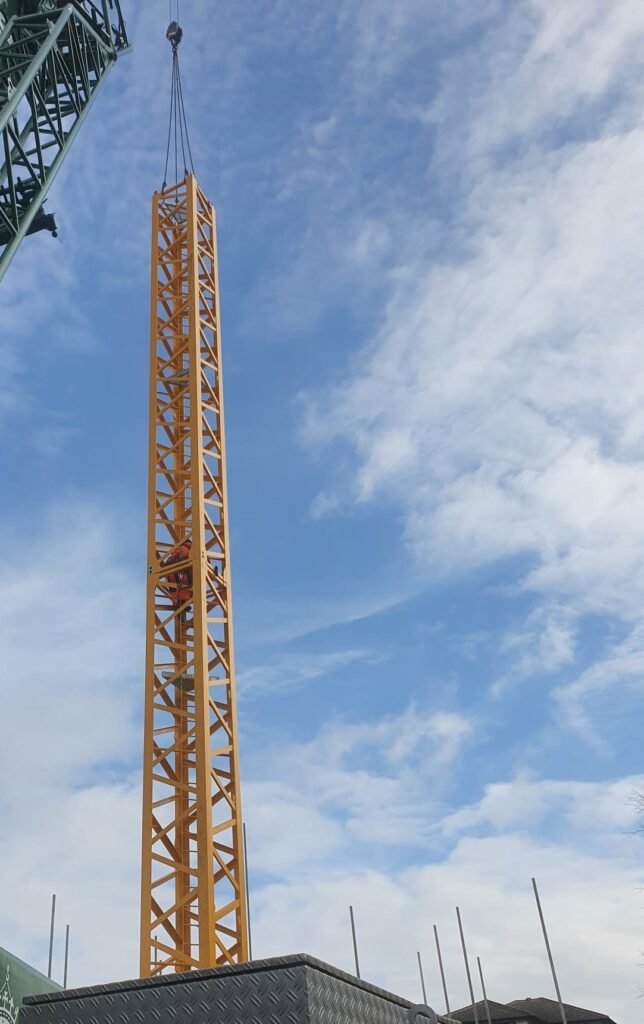
BS 7121-5 says the maker’s sequence for fitting the jib and the counterweight should be followed strictly, so the part-built crane stays stable up to the highest wind speed the maker allows for erection. The CPA has recorded a luffing jib that fell over while it was being assembled on the ground, once its slings were taken off, and it advises supporting a jib on as wide a base as possible (TIN 033).
The mobile crane and its ground
The mobile crane sets up close to the base, on ground that can take the loads through its outriggers, the legs it stands on while lifting. TCIG 0701 has mats or grillages laid under the outriggers to spread those loads, and BS 7121-5 has the appointed person make sure the ground can carry them. The method statement covers its access route and any road closure. Two other guides go further: What Size Outrigger Mats Do I Need? and Crane Site Preparation: Getting Ready for a Mobile Crane.
Exclusion zone and weather
While the crane goes up, the principal contractor fences off an exclusion zone below and keeps out everyone not involved, sizing it with the crane supplier from what could fall (BS 7121-5 and the CPA’s note on exclusion zones, TIN 032).
BS 7121-5 keeps erection out of the hours of darkness, and within the maker’s wind limit for erection. That limit can be lower than the one for normal lifting, and it can be set by the mobile crane’s configuration as well as the tower crane. Our wind check tool shows the Met Office forecast for a site and lets you adjust the gusts to the height of the lift. A separate guide, Crane Wind Speed Limit: Lifting in Wind, covers wind more widely.
Step 3
Step 3: Tests and thorough examination before use
Once the crane is built, TCIG 0701 calls for a full check that every function works, and a test of the rated capacity indicator and limiter, the devices that warn the operator of an overload and stop it. Then comes the thorough examination: a systematic and detailed examination of the crane and its safety-critical parts by a competent person, recorded in a written report. Our guide What is a LOLER inspection? explains how these work.
In Great Britain, regulation 9 of LOLER requires lifting equipment whose safety depends on how it is installed to be thoroughly examined after installation and before it is first put into service, and again after it is assembled at a new site. The CPA’s guide to inspecting tower cranes (TCIG 0801) applies this to every tower crane erected at a new site. It adds that a crane changed on site, for example to a new height or jib length, needs a further thorough examination before it goes back into service. Northern Ireland has the same duty in regulation 9 of the Lifting Operations and Lifting Equipment Regulations (Northern Ireland) 1999.
Whether the crane is also load tested is the competent person’s call, as part of the examination, under HSE’s code of practice and guidance on LOLER (L113), which the CPA’s note on load testing (TIN 045) quotes. The same note records that BS 7121-2-5, the British Standard on inspecting tower cranes, recommends overload testing alongside the thorough examination after each erection and each reconfiguration, such as adding or removing ties.
Under TCIG 2602, the supplier usually arranges this first thorough examination before the crane is handed over for lifting. TCIG 0701 has the erector complete and sign a handover sheet, and the operator is given familiarisation on the crane before using it.
Climbing
How a tower crane climbs as the building rises
A very tall crane, or one on a city site with no room for a big enough mobile crane, gains height by climbing: a hydraulic jacking system extends its tower with no second crane involved. A crane reaches its working height in one of three ways:
| Method | How it works |
|---|---|
| Free-standing | The crane stands on its base alone, up to the free-standing height the base design allows. |
| External climbing | A climbing frame around the tower raises the top on hydraulic cylinders so a new mast section can go in underneath. The tower is tied with steel collars and legs to a structure beside it, such as the building. |
| Internal climbing | The crane stands inside the building, held in collars at two floor levels, and jacks itself up through openings left in the floors as the building rises. |
For an external climb, the climbing frame is fitted around the tower and raised to the top, and the crane lifts a new mast section across to it. The crane is then put in balance, so the weight of its top sits over the climbing cylinders, and the operator leaves the cab so the crane cannot slew by accident (TCIG 1101, the CPA’s guide to climbing). The cylinders raise the top far enough for the new section to be pulled into the gap and fixed to the section below, and the cycle repeats.

Climbing has its own wind limit from the maker, and BS 7121-5 notes it is usually well below the limit for erection and dismantling. Ties are temporary works like the base, and TCIG 1101 has each tie design checked independently. After a climb, the same guide has the crane thoroughly examined and tested, in line with LOLER and BS 7121-2, and BS 7121-5 adds that it should not go back to work until the maker has approved its new configuration.
Dismantling
How a tower crane is taken down
Dismantling is done by an erection team under an erection supervisor, like erection, following the maker’s instructions and its own method statement. Where the maker’s manual says dismantling is erection in reverse, BS 7121-5 has the appointed person confirm that holds for the crane, and ask the maker if in doubt. A crane that was climbed can be climbed down, with mast sections taken out one at a time.
Before dismantling starts, TCIG 0701 has the team confirm the crane is still where the site plan shows it, and look for new hazards on site, with particular attention to space for the mobile crane. The same guide warns that buildings have been built around a crane in a way that made it very hard and costly to remove. BS 7121-5 has the access for dismantling and removing the crane considered when the crane’s position is chosen.
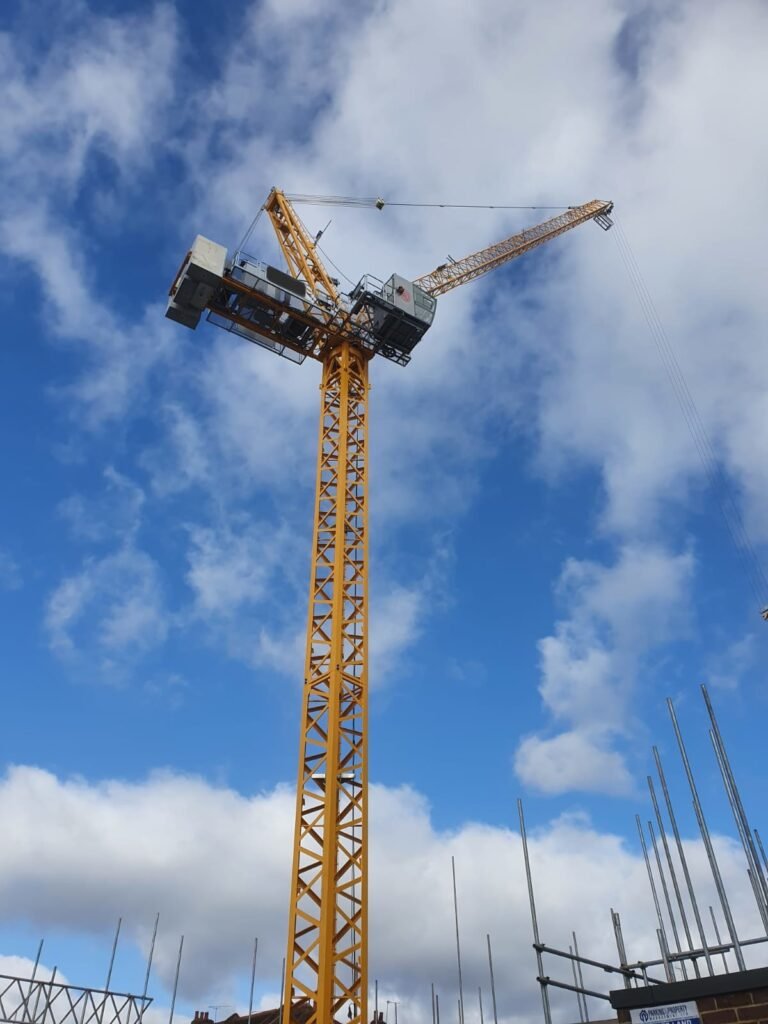
When a part comes off at height, the mobile crane takes its full weight as soon as the pins holding it are out, and there is no safe way to set it back. BS 7121-5 suggests picking an assisting crane with capacity in hand, in case the part is badly slung or jerks free. Under TCIG 2602 the site provides the ground for the mobile crane again, with what it knows about buried services and underground structures.
From our lifts
We ask for the heaviest part of the tower crane, how far from the base it has to go, and the order it goes up in. Then we look at where the mobile crane will stand, what is under that ground, and how the lorries and the crane get in. The site’s competent person confirms the ground can take the outrigger loads we send.
The space for the mobile crane has gone. At the start it was an empty plot, and by the dismantle there is a building, scaffold or a new drain run where the crane needs to stand. Then the crane has to reach further, and a bigger crane is needed. When that happens the lift waits until the appointed person has planned it again.
Plan the dismantle on the day you plan the erection. Mark where the mobile crane will stand to take the tower crane down, and keep that area and the route to it clear for the whole job. Send us the site plan early, so the crane that comes at the end can still reach every part.
Questions
Common questions
Does it take a crane to build a crane?
Yes, for a tower crane built from parts. A mobile crane, or another tower crane already on the site, lifts the mast sections and the top of the crane into place (BS 7121-5). A tall crane can then climb, adding its own mast sections with a hydraulic frame.
How do tower cranes make themselves taller?
By climbing. A climbing frame around the tower takes the weight of the crane’s top on hydraulic cylinders and raises it, and a new mast section goes into the gap underneath. The crane lifts that section up itself. A crane standing inside a building can instead jack itself up through the floors, held in collars, as the building rises.
How do tower cranes stay upright?
Through the base, and on a tall crane through ties. An engineer designs the base from the crane maker’s loads, including those on the crane out of service in strong wind, and another engineer checks it. Above its free-standing height, the tower is tied to a structure beside it, such as the building going up.
How are tower cranes taken down?
Under an erection supervisor, following the maker’s instructions and a method statement written for the dismantle. A mobile crane lowers the parts, carrying each one’s whole weight once its pins are out, so BS 7121-5 suggests a crane with spare capacity. A climbed crane can first be climbed down, removing mast sections one at a time.
How are tower cranes moved?
A tower crane built from parts is taken down into sections for the lorries, then built again at the next site. In Great Britain, LOLER then requires another thorough examination there before the crane is used. Some tower cranes travel along rails on a ballasted base, and self-erecting models fold up for the road.
Does a tower crane need a thorough examination after it is put up?
Yes. In Great Britain, LOLER regulation 9 says equipment that relies on being installed correctly must be thoroughly examined once it is put up, and again each time it is assembled at a new site, before anyone uses it. CPA guidance applies this to every tower crane erection, and to changes on site such as a new height or jib length.
Who is responsible for erecting a tower crane?
Usually the crane supplier. CPA guidance (TIN 019) gives the supplier overall responsibility for erecting and dismantling the crane. The contractor in control of the site assesses and prepares the base and the ground for the mobile crane (CPA TCIG 2602). After handover, the site’s appointed person plans the lifts on crane hire, and the lifting contractor’s on a contract lift.
How long does it take to put up a tower crane?
There is no set time. BS 7121-5 has the method statement set out the tasks for each day, with start and finish times. The concrete base has to reach its design strength first, and erection stops in darkness and above the maker’s wind limit, so short winter days and windy weather can stretch the programme.
Get help
Get help with a tower crane
We supply tower cranes on contract lifts, with erection and dismantling arranged as part of the job. Call us on 0800 008 6096 or email office@synergy-lifting.co.uk. Send us a site plan, the heaviest load, the furthest reach and how long you need the crane, and we will come back with a quote.
Find out more about our crane hire and contract lifting service.
Related
Find out more
Get a quote
Ready for a quote?
Send us the details and we will come back with a quote, usually the same day for a desktop survey.
Or call 0800 008 6096