

Contents
Overview
The parts of a mobile crane and what each one does
The main parts of a mobile crane are the boom and any jib on its end, the hoist rope and hook block that carry the load, the superstructure that turns on the slew ring, the carrier it drives on, and the outriggers and counterweight that keep it steady.
Safety systems in the cab watch the load against what the crane can lift.
Tower cranes have parts of their own, covered in Parts of a Tower Crane Explained and in our guide What Is a Tower Crane?
In short
- How the parts are rigged sets what the crane can lift: the load chart in use depends on the boom length, any jib, the counterweight and the outrigger spread.
- Each crane’s own data sheet lists the ways it can be rigged, so it is the place to check what a particular crane can be set up with.
- On a mobile crane built to BS EN 13000, the limiter judges the load against the set-up entered in the cab, which is why the operator checks that setting against the load chart.
Our crane hire and contract lifting service supplies mobile cranes with their operators. On a contract lift, our own appointed person plans the lift and writes the lift plan.
Sources
Where this guidance comes from
The crane figures on this page are for one crane, Liebherr’s LTM 1060-3.1, a 60 t all-terrain crane, taken from Liebherr’s data sheet and product page and matching our crane library page for it. They hold for that crane only and are shown as examples. Other makers build the same parts to other sizes, and Liebherr’s name for a part is sometimes not the one heard on site: its data sheet calls the jibs for this crane a single folding jib and a double swing-away jib.
The safety systems are described from BS EN 13000, the European product standard for mobile cranes, in our own words through our guide to it. For a real lift, use the data and instructions for the crane on site from its maker, and have the lift planned by a competent person.
At a glance
The main parts of a mobile crane at a glance
The table runs from the hook down to the ground, then adds the counterweight and the safety systems.
| Part | What it does |
|---|---|
| Hook block | Hangs on the end of the hoist rope and carries the hook the slings attach to. |
| Hoist rope and winch | A wire rope that raises and lowers the hook, wound on and off a winch drum. |
| Jib or fly jib | A lighter extension fitted to the head of the boom for extra height or reach. |
| Boom | The main arm. It is raised and lowered on its pivot and, on a telescopic crane, extended in sections. |
| Superstructure | The upper works that turn, carrying the boom, the crane cab, the winch and the counterweight. |
| Slew ring | The large bearing between the superstructure and the carrier that lets the upper works turn. |
| Carrier | The chassis the crane drives on, with its axles, engine and driver’s cab. |
| Outriggers and pads | Legs that extend from the carrier and lift the crane off its wheels, each ending in a pad. |
| Counterweight | Removable weights on the back of the superstructure that balance the load. |
| Rated capacity indicator and limiter | The indicator warns as the load nears capacity. The limiter then allows only movements that reduce the load. |

Lifting
The boom, jib, hoist rope and hook block
The boom and its sections
An all-terrain crane lifts with a telescopic boom: a base section with narrower sections nested inside it, pushed out hydraulically to the length the lift needs. The LTM 1060-3.1 has a base section and five telescopic sections, giving a boom from 10.3 m fully retracted to 48 m fully extended. A crawler crane usually works with a lattice boom instead, assembled from sections on site, as our guide What is an all-terrain crane? explains.
Raising the boom brings the hook in towards the crane and lowering it sends the hook out. Boom length and radius are the two values a load chart is read against, which our guide How to Read a Crane Load Chart covers.
The jib or fly jib
A jib is a lighter extension fitted to the head of the boom when a lift needs more height or reach than the boom alone gives, for example to reach over a roof edge. It is also called a fly jib, the term BS 7121-3 uses. Liebherr offers a 9.5 m single folding jib for the LTM 1060-3.1, or a double swing-away jib of 9.5 m to 16 m, set at 0, 20 or 40 degrees to the boom. A jib has its own load tables, and the extra reach comes at the cost of capacity, so whether to fit one is decided in the lift plan.
The hoist rope and hook block
The load hangs from the hoist rope, a wire rope wound on a winch drum on the superstructure. On the LTM 1060-3.1 a hydraulic motor turns the drum through a gearbox built into it, with a spring-loaded brake to hold it. From the drum the rope passes over pulleys called sheaves at the boom head before dropping to the hook block.
Passing the rope back and forth between sheaves in the boom head and the hook block, known as reeving, shares the load between more lines of rope. Grove’s product guide for its GMK3060 lists a five-sheave hook block for its heaviest duties and, at the light end, a single-line overhaul ball, which it also calls an overhaul weight.
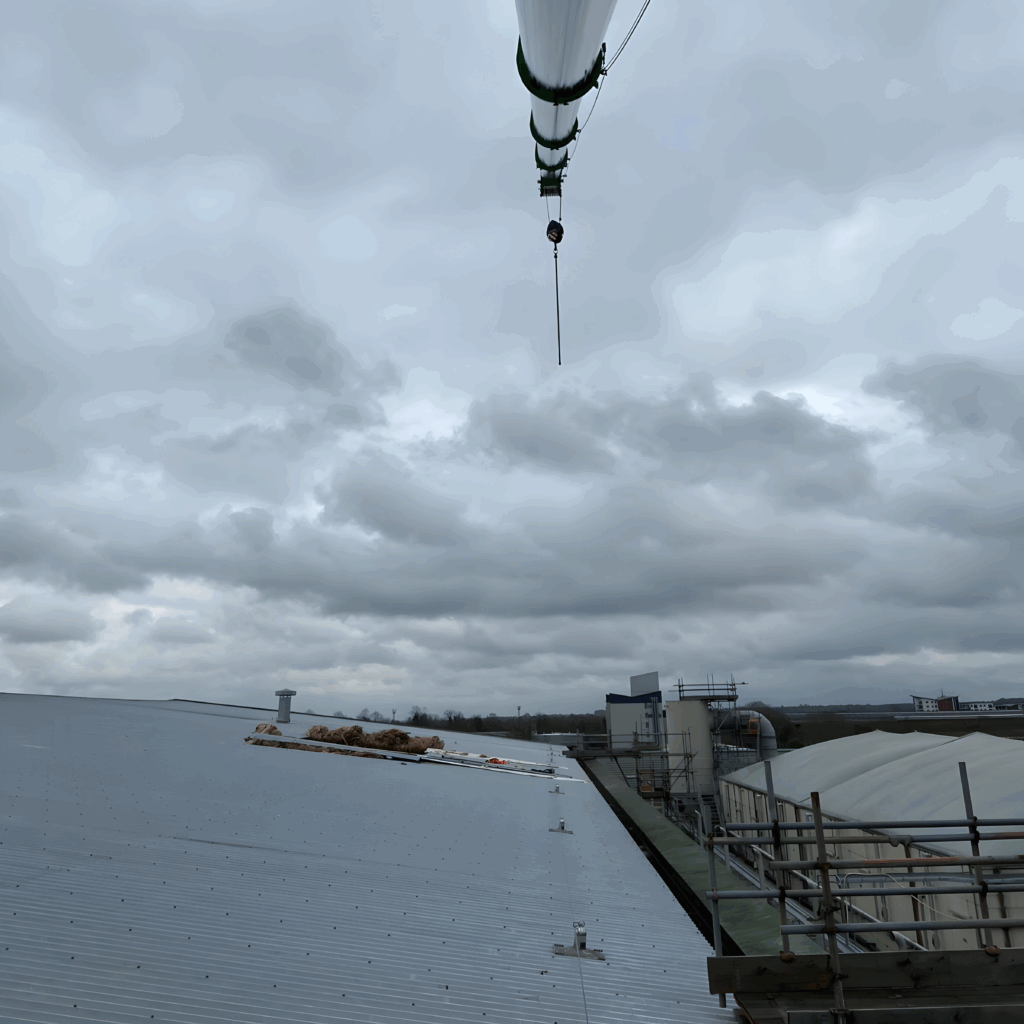
In Great Britain, HSE’s guidance in L113 says that in some cases, such as with a mobile crane, the hook block and other lifting accessories should be counted as part of the load. Their weight comes off what is left for the load itself, which is why our guide What size crane do I need? adds them in.
Turning and driving
The slew ring, superstructure, cabs and carrier
Slew ring and superstructure
Slewing means turning the crane’s upper works to swing the load round. That upper part is the superstructure, and Liebherr’s data sheet lists the crane cab, the hoist, the slewing gear and the counterweight under it for the LTM 1060-3.1, with the boom mounted on it as well.
The superstructure turns on the slew ring, the large bearing that joins it to the carrier. On the LTM 1060-3.1 the slewing gear is a hydraulic motor with a gearbox and a spring-loaded brake. A lift’s radius is the horizontal distance from the centre of the slew ring to the load’s centre of gravity, at the furthest point the load reaches, as What size crane do I need? defines it.
Crane cab and carrier
An all-terrain crane has two cabs. The crane cab sits on the superstructure and turns with the boom, and on the LTM 1060-3.1 it tilts back by 20 degrees. The driver’s cab sits on the carrier, the chassis that takes the crane to site under its own power, along with the engine and the outriggers.
The LTM 1060-3.1 runs on three axles, all of them steered. Larger all-terrain cranes have more axles, up to nine on the largest.

Stability
Outriggers and counterweight
Outriggers and pads
A mobile crane does its lifting standing on its outriggers. Each one is a beam that slides out sideways from the carrier, with a jack at its end that pushes down and lifts the crane off its wheels. The LTM 1060-3.1 has four, which extend out and down hydraulically, worked by remote control, with automatic levelling.
The pad is the foot at the bottom of each jack, and it is part of the crane. Mats go under the pads to spread the load over more ground, and our guide What Size Outrigger Mats Do I Need? covers sizing them. On our contract lifts the site gets our outrigger loads and mat details, with our ground bearing pressure calculations. The site’s own competent person then confirms the ground can take those loads, because the site knows what lies under it.
How far the outriggers are extended changes what the crane can lift. Under BS EN 13000 the outriggers are marked at full extension and at every part extension the load charts allow, and an amendment to the standard added monitoring against wrong outrigger settings, as our BS EN 13000 guide explains.
Counterweight
Counterweight is the set of removable weights on the back of the superstructure that balances the load. It turns with the superstructure, so the plan leaves room behind the crane for the counterweight’s tail swing as it slews. The LTM 1060-3.1 travels with 5.5 t of counterweight on board, at 12 t per axle, and Liebherr offers 7.3 t of additional counterweight for 12.8 t in total. Larger cranes have their counterweight brought on separate lorries and fitted on site.
Each counterweight has its own load charts, so the crane has to be rigged with the counterweight the plan was worked out for.
Safety systems
The rated capacity indicator and limiter
In the cab, the crane’s safety systems compare the load on the hook with what the crane can lift in its current set-up. Under BS EN 13000, the rated capacity indicator gives a continuous warning, seen and heard, as the load nears capacity, and warns people in the danger zone as well as the operator. Once the load reaches the limiter’s set point, a level the standard puts between 100% and 110% of rated capacity, the rated capacity limiter allows only movements that reduce it.
Both work from the configuration set in the cab. The standard keeps that setting on show so the operator can check it against the load chart, and it cannot be changed while the crane holds a load. The same standard calls for a hoist limit, which stops the hook block being drawn up into the head of the boom or jib.
HSE’s L113 notes that rated capacity indicators used to be called automatic safe load indicators. Some makers still use the older wording: Liebherr lists a LICCON2 safe load indicator and a hoist limit switch for the LTM 1060-3.1. Our guide to HSE L113 explains what the document is.
From our lifts
We check the crane is rigged the way the plan says: the boom length, the jib if one is needed, the hook block and the counterweight. Then we watch the outriggers go out to the spread on the plan, with the pads centred on the mats. The operator sets that configuration in the cab, and we check it matches the load chart.
The counterweight lorry is late, or there is no room for it to park beside the crane. Without the full counterweight the crane is on a different chart, and the heavier lifts have to wait. The other one is a jib needed on the day that nobody planned for. When that happens the appointed person works the lift out again.
Tell us early if the load has to go over a roof or a wall, because it sets the boom length and whether a jib is needed. Send photos of the space around the set-up position too. The crane needs room for its outriggers and counterweight, and the lorries that bring them need somewhere to stand.
Questions
Common questions
What are the arms of a crane called?
On a mobile crane the main arm is the boom, and any extension on the end of it is the jib. On a tower crane the long arm that carries the load is the jib, and the shorter arm behind it, holding the counterweight, is the counterjib.
What is the difference between a jib and a boom?
On a mobile crane, the boom is the main arm the crane raises, lowers and extends. The jib is an add-on at the boom’s tip that gains height or reach at some cost to capacity, so it has load tables of its own. On a tower crane, jib is the name for the main arm itself.
What is the rotating part of a crane called?
The superstructure. It carries the boom, the crane cab, the hoist and the counterweight, and it turns on the slew ring, the large bearing on top of the carrier. Turning it is called slewing. The radius of a lift is the horizontal distance from the centre of the slew ring to the load’s centre of gravity, at its furthest point.
What do you call the hook on a crane?
The hook is part of the hook block, the sheaves and hook on the end of the hoist rope. Grove also lists a single-line overhaul ball for light work on its GMK3060. In Great Britain, HSE’s guidance on LOLER gives a mobile crane as a case where the hook block should be counted as part of the load.
What is the cable on a crane called?
The hoist rope. It is a steel wire rope that the winch drum pays out and winds in to lower and raise the hook. Between the boom head and the hook block it is reeved through sheaves, and a heavy block has more sheaves so the load is shared between more lines of rope.
What is a fly jib?
A fly jib is a jib fitted to the boom head when a lift needs extra height or reach. It has its own load tables. On the largest all-terrain cranes the jib sections can arrive on separate lorries. Liebherr lists a single folding jib and a double swing-away jib for its LTM 1060-3.1.
Who checks the parts of a crane?
A competent person. In Great Britain, regulation 9 of LOLER requires employers to have a crane exposed to conditions causing dangerous deterioration thoroughly examined at least every 12 months, or 6 months where it lifts people, or under an examination scheme, and after exceptional circumstances that could affect its safety. Our guide What is a LOLER inspection? covers the checks in between.
Get help
Get help with a crane for your lift
Call us on 0800 008 6096 or email office@synergy-lifting.co.uk. Send us the weight of the load and how far from where the crane could stand it has to go. Tell us what it has to clear on the way, and we will recommend a crane and quote for the lift.
Find out more about our crane hire and contract lifting and lift and shift services.
Related
Find out more
Get a quote
Ready for a quote?
Send us the details and we will come back with a quote, usually the same day for a desktop survey.
Or call 0800 008 6096