

Contents
Overview
What is a tandem lift and when is one used?
A tandem lift is a lift where two or more cranes carry one load between them, also called a multi-crane lift. It is used when a single crane cannot do the job. BS 7121-1 treats it as a complex lift, and it needs careful planning because each crane’s share of the weight can change while the load moves.
In short
- Any lift where cranes share a load sits in the complex category of BS 7121-1, so the appointed person visits the site beforehand and attends the lift on the day.
- For mobile cranes on a shared lift, BS 7121-3 recommends down-rating, possibly by 30% or more, unless every factor is accurately known and watched by instruments.
- In Great Britain, LOLER makes planning every lift a legal duty, and HSE names the tandem lift as an example of a lift that needs a written plan.
Through our crane hire and contract lifting service you can hire the cranes, or have the whole lift planned to BS 7121 and run for you.
When it is used
When a tandem lift is needed
For any heavy or awkward load, the first question is whether one crane can lift it. BS 7121-3, the code of practice for mobile cranes, says two or more cranes should share a load only when a single crane cannot do the job.
One larger crane may do it instead. A long load can also stay on a single hook, with a spreader or lifting beam carrying it from points spaced along its length.
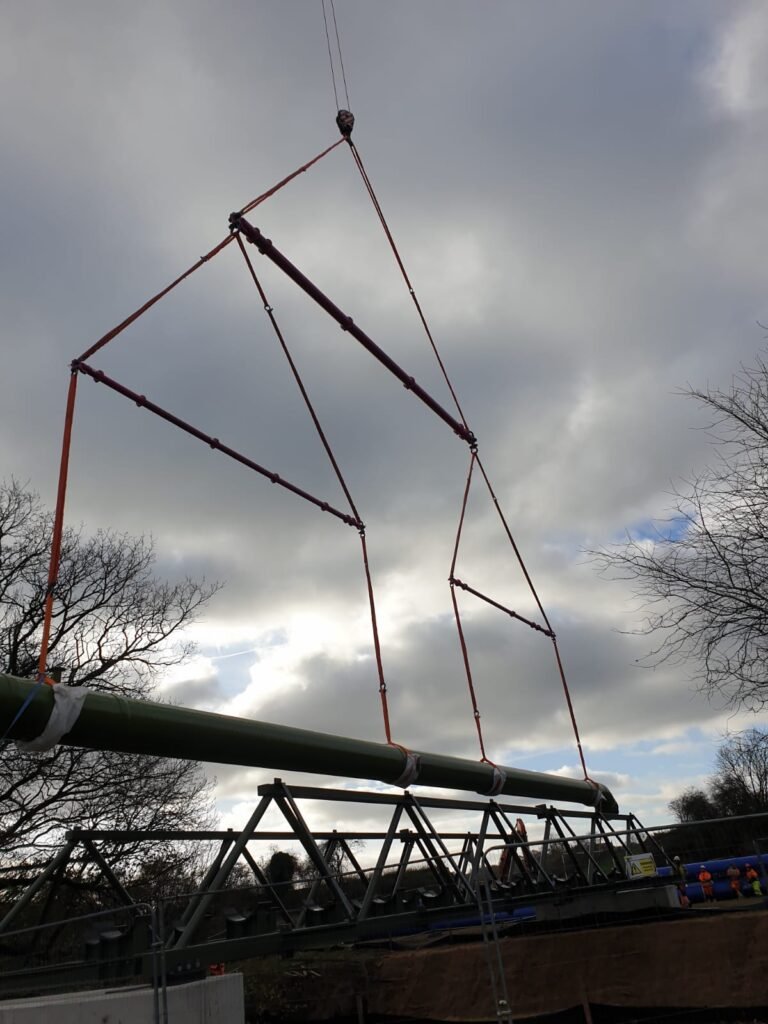
Some loads still need two cranes. Our guide What size crane do I need? gives two cases: a load lifted by two cranes together, and a load turned over in the air using a second crane. Our project loading two 60te rail machines for export shows a tandem lift in practice, with a 3D model of the lift.
Mixing crane types is a separate question. BS 7121-3 says mobile cranes should not share a lift with tower cranes or other lifting equipment. That is guidance in a code of practice, so a job that needs the mix can depart from it, but only for a reason the appointed person can justify and with extra care in the planning. For tower cranes, BS 7121-5 keeps lifts with more than one crane for exceptional cases.
Complex lift
Why a tandem lift counts as a complex lift
In Great Britain, regulation 8 of LOLER puts a duty on employers: every lifting operation must be properly planned by a competent person and appropriately supervised. Northern Ireland sets the same duty in regulation 8 of its 1999 regulations, and our guide to LOLER covers the rest of the law.
HSE’s guidance on planning lifting operations gives the tandem lift using multiple cranes as its example of a much more complex lift. For a lift like that, it says a written plan should be drawn up by a person with significant and specific competence: adequate training, knowledge, skills and expertise.
Under BS 7121-1, the British Standard code of practice for crane lifts, sharing a load between cranes is one of the things that makes a lift complex, the highest of its three categories. For a complex lift the appointed person, who plans the lift and has overall control of it, visits the site and prepares a dimensioned drawing. The drawing marks where each crane stands, the route the load takes, where it is picked up and put down, and any exceptional hazards. The appointed person then attends the lift.
The table sets a tandem lift with mobile cranes beside a lift with one crane, using those sources and BS 7121-3. BS 7121-3 covers mobile cranes, and its points are recommendations.
| Point | Lift with one crane | Tandem lift with mobile cranes |
|---|---|---|
| Lift category (BS 7121-1) | Basic, intermediate or complex, set by the hazards | Complex |
| Written plan | Detail in proportion to the risk, and a routine basic lift can use a generic plan | A written plan from someone with significant and specific competence (HSE) |
| Capacity | The load chart at the radius the lift needs | Each crane’s share checked on its own chart, and down-rated where BS 7121-3 recommends it |
| The cranes | One crane chosen for the load | Should be of equal capacity and similar in make and configuration (BS 7121-3) |
| Control on the day | The appointed person has overall control and the crane supervisor directs the lift (BS 7121-1) | As for one crane, with one person in overall control of all the cranes (BS 7121-3) |
What goes into the plan itself is set out in our guide What is a lift plan?, and a separate guide, Appointed Person and Other Lifting Roles, covers the people who carry it out.
Load sharing
How the load is shared and the cranes down-rated
Working out each crane’s share
Start from the load’s weight and the position of its centre of gravity. With a crane over each lifting point and the hoist ropes hanging straight down, the crane nearer the centre of gravity carries more. Its share is the load’s weight multiplied by the distance from the centre of gravity to the other crane’s lifting point, divided by the distance between the two lifting points.
Each crane also lifts its own hook block (the hook and its pulley block) and the slings and shackles below it. Our guide What size crane do I need? counts the hook block and all the lifting gear as part of the weight for any crane lift, so they are added to that crane’s share.
Why the shares can change
The split worked out on paper holds while the load hangs as planned. What size crane do I need? notes that on a tandem lift the shares between the cranes change during the lift. Our guide to load cells adds that each crane has to be able to carry its part of the weight allowing for that change, and that a load cell on each hook shows the actual split once the load leaves the ground.
Down-rating the cranes
Down-rating means planning a crane to lift less than its chart allows. BS 7121-3 recommends down-rating mobile cranes that share a load, possibly by 30% or more. The exception is a lift where every factor is known accurately and monitored by instruments. This is a code of practice recommendation for mobile cranes, and the appointed person who plans the lift decides whether it applies and sets the figure. HSE’s planning guidance also lists derating among the points a lift plan may need to cover.
Each crane also puts its own loads through its outriggers, the legs it sets down to stand on. As for any mobile crane, BS 7121-1 has the appointed person get a competent person’s assessment that the ground can carry them. A separate guide, What Size Outrigger Mats Do I Need?, covers outrigger loads and mats.
Example
A tandem lift example (a made-up job)
This example is invented to show how the sums work. Two mobile cranes lift a steel frame off a trailer and set it down on its base. Every figure is a round number for illustration.
| Part of the plan | What this example says |
|---|---|
| Job and category | One 20 t steel frame, 10 m between its lifting points, lifted by two cranes, one over each lifting point. Complex, because two cranes share the load. |
| The load | The maker’s drawing puts the centre of gravity 3.25 m from lifting point A, which is 6.75 m from lifting point B. |
| Crane A’s share | 20 t × 6.75 m ÷ 10 m = 13.5 t |
| Crane B’s share | 20 t × 3.25 m ÷ 10 m = 6.5 t. The two shares add up to the 20 t frame. |
| Hook block and lifting gear | 0.5 t on each crane, so crane A lifts 14 t and crane B lifts 7 t. |
| Down-rating | The load cells show the weight on each hook, but not every factor in this lift is known accurately and monitored by instruments. So the appointed person follows BS 7121-3’s recommendation and, for this example, sets the down-rating at 30%. Each crane is planned to 70% of its chart capacity. |
| Capacity needed | Crane A: 14 t ÷ 0.7 = 20 t on its chart at the radius it works at. Crane B: 7 t ÷ 0.7 = 10 t at its radius. |
| The cranes | Two identical cranes: the same make and model, with the same counterweight and outrigger set-up. |
| Ground | A competent person’s assessment confirms the ground under each crane can carry its outrigger loads. |
| Control | One person in overall control of both cranes, with a load cell on each hook showing the split. |
| Sequence | Both cranes take the strain together and lift the frame just clear of the trailer. They stop while the person in control checks it hangs level and the readings match the plan, then lift and lower on that person’s instructions. |

On a real job the weight and centre of gravity come from the load’s maker, and each crane’s capacity comes from its own chart. In Great Britain the lift has to be planned by a competent person, and on a crane lift BS 7121 gives that planning, including any down-rating, to the appointed person. Reading capacity off a chart is covered in a separate guide, How to Read a Crane Load Chart.
On the day
Control and signals during a tandem lift
BS 7121-3 recommends one person in overall control when mobile cranes share a load. HSE’s planning guidance says supervision should be in proportion to the risk, taking account of the competence and experience of the people doing the lift.
Signals follow the rule for any crane lift. Under BS 7121-1 each crane operator takes signals from one person at a time, though anyone can give an emergency stop. A crane coordinator is a different role: BS 7121-1 uses it where more than one crane works on a site, to plan the order of crane movements so the cranes do not hit each other or other plant.
Where a tandem lift can go wrong
HSE’s planning guidance lists the risks a lift plan has to address, including overload, overturning, working under suspended loads and hazards close by. On a tandem lift, a change in the split between the cranes can put more weight on one crane than its share in the plan. Down-rating leaves each crane spare capacity for that, and a load cell on each hook shows the change as it happens.
Wind acts on both cranes and on the load between them. Under BS 7121-1 the method statement records the highest wind speed for the lift. Our wind check tool shows the Met Office forecast for a site and lets you adjust the gusts to the height of the lift. A separate guide in this series, Crane Wind Speed Limit: Lifting in Wind, explains how wind limits are set.
Hire or contract
Tandem lifts on crane hire and contract lifts
Hire the cranes, and the lift stays your responsibility. HSE says planning and running a lift rests with the user unless the hire company explicitly takes that on as a contract lift. On an operated hire, BS 7121-1 has the hirer provide the appointed person who plans the tandem lift, while the crane owner supplies maintained cranes and competent operators.
On a contract lift, our own appointed person plans the lift and writes the lift plan. On our contract lifts we also send the site our outrigger loads and ground bearing pressure calculations for each crane position, with the mat details, and the site’s own competent person confirms the ground can take them. The two routes are compared in Crane hire or contract lift: what is the difference?
From our lifts
We check the load’s weight and where its centre of gravity sits, because that sets each crane’s share. Then we work out each crane’s load with its hook block and lifting gear added, and check both charts at the radius each crane works at. On the day, one person gives every instruction, and the load comes up just clear first so we can check it hangs level.
The cranes can’t set up where the plan put them. One crane ends up a few metres further out, its radius grows and its capacity drops, so the split we planned no longer works. The other is a load heavier at one end than the drawing showed. Either way the lift stops and the appointed person checks the plan again.
Ask whether one bigger crane could do it before you plan for two. One crane means one set of outriggers and one operator, and the lift is simpler to run. If it does need two, send us the maker’s drawing with the weight and centre of gravity marked, and photos showing where both cranes could stand.
Questions
Common questions
What is a tandem lift?
A tandem lift is one where two or more cranes lift a single load together. BS 7121-1, the British Standard code of practice for crane lifts, puts any lift with cranes sharing a load in its complex category. For mobile cranes, BS 7121-3 says one should be used only when a single crane cannot do the job.
How do you calculate a tandem lift?
Start with each crane’s share. Multiply the load’s weight by the distance from its centre of gravity to the other crane’s lifting point, then divide by the distance between the two lifting points. Add that crane’s hook block and lifting gear, then check its load chart has enough capacity at its radius after any down-rating.
How much should cranes be down-rated for a tandem lift?
Under BS 7121-3, mobile cranes sharing a load should be down-rated, possibly by 30% or more, unless every factor in the lift is known accurately and monitored by instruments. It is a code of practice recommendation for mobile cranes, and the appointed person who plans the lift decides whether it applies and how much to reduce each crane.
Do you need a lift plan for a tandem lift?
Yes. In Great Britain, LOLER requires every lifting operation to be planned by a competent person. For a tandem lift using several cranes, HSE’s guidance says the plan should be written and drawn up by someone with significant and specific competence. BS 7121-1 also has the appointed person visit the site and attend the lift.
Do the cranes in a tandem lift have to be the same?
They should be closely matched. BS 7121-3 recommends that mobile cranes sharing a load have equal capacity and are similar in make and configuration. In practice that can mean two cranes of the same make and model, rigged alike. Any departure from it has to be justified by the appointed person who plans the lift.
Can a tandem lift use a mobile crane and a tower crane?
Not as a rule. BS 7121-3 recommends that mobile cranes do not share a load with a tower crane or other lifting equipment. A code of practice can be departed from, but only for a reason the appointed person can justify and with extra care in the plan. BS 7121-5 keeps multi-crane tower crane lifts for exceptional cases.
Can overhead cranes lift a load in tandem?
Yes. The code of practice from the Lifting Equipment Engineers Association (LEEA) says bridge and gantry cranes are sometimes used to share a load, working in unison. Each crane’s safe working load must cover its share, allowing for any variation, and the cranes must be able to work at the distance apart the lift needs.
Get help
Get help planning a tandem lift
Call us on 0800 008 6096 or email office@synergy-lifting.co.uk. Send us the maker’s drawing of the load with its weight and lifting points marked. Add photos or a site plan showing where cranes could stand. Before we quote, we look at whether one crane could do the job.
Find out more about our crane hire and contract lifting and industrial plant dismantling services.
Related
Find out more
Get a quote
Ready for a quote?
Send us the details and we will come back with a quote, usually the same day for a desktop survey.
Or call 0800 008 6096