

Contents
Overview
The centre of gravity when lifting a load
The centre of gravity when lifting a load is the point the load’s whole weight acts through, and the crane hook must be directly above it for the load to come up level. Find its position from the maker’s data or by working it out from the weights of the parts, then confirm it with a trial lift.
On a machine it is rarely in the middle. A motor or a heavy casting pulls it towards one end, and it can sit well above the base.
In short
- Sling legs nearer the centre of gravity carry more of the weight, so each is rated for its own share.
- Slings attached above the centre of gravity keep a load upright. Attached below it, a tall, narrow load can roll over.
- Makers can mark it on the crate with a symbol, or give its position in the transport instructions.
- Contents that can move, such as liquid in a part-filled tank, shift the centre of gravity during the lift.
On a contract lift, our own appointed person plans the lift and writes the lift plan.
Balance
Why the hook must be over the centre of gravity
With the hook off to one side, one side of the load lifts first, and the load swings sideways as it comes free before settling at an angle. Anyone standing beside it is in the path of that swing. For the load to stay level, the hook has to be vertically above its centre of gravity.

Once a load tilts, its sling legs no longer carry equal shares, more so where the angle between the legs is small.
Slings above or below the centre of gravity
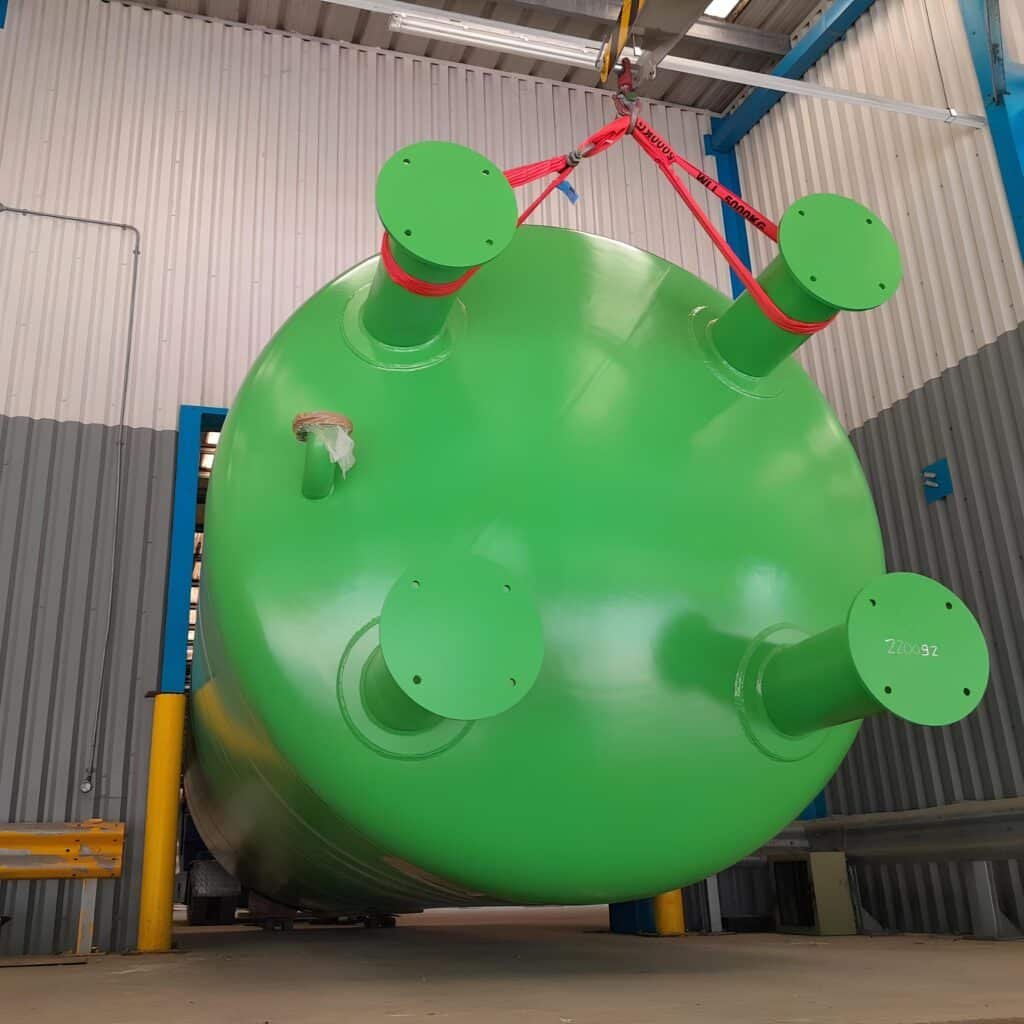
Whether the load then stays upright depends on where the slings are attached. Slung from points above its centre of gravity, with the slings spread around it, a load stays upright. Slung from points below it, such as lugs near the base of a tall, narrow cabinet, it can roll over in the slings.
Finding it
Where to find the centre of gravity of a machine
Start with the maker. The INDEX group, a German maker of lathes, gives the centre of gravity of its TRAUB TNL12 sliding headstock lathe as three measurements in its transport instructions, and warns that it sits high. Ask the maker or supplier for the position along with the weight before the lift is planned.
Check the crate and the machine as well, because makers can mark the centre of gravity on one or the other with a symbol. ZSK, which makes embroidery machines, marks the approximate centre of gravity on its transport crates this way.
If a machine has been modified, or has had parts added or removed, the maker’s figures may no longer apply. Work it out again from what is there now.
Working it out
How to work out the centre of gravity of a load
For a solid block or a beam of even section made of one material, the centre of gravity is at its geometric centre. Where a load has parts of different weights, such as a motor at one end of a frame, find it by taking moments: each part’s weight multiplied by its distance from a fixed point.
- Choose a reference point, such as one end of the load’s base.
- For each part, multiply its weight by the distance from the reference point to that part’s own centre of gravity.
- Add up the results and divide by the total weight. The answer is the distance from the reference point to the centre of gravity.
- Repeat across the width to fix its position in plan, and up the height to see how high it sits.
A worked example
A steel frame 4 m long weighs 4 t, and its own centre of gravity is in the middle, 2 m from the left end. A 2 t motor sits on it, with its centre of gravity 3.5 m from the left end.
| Part | Weight | Distance from left end | Weight × distance |
|---|---|---|---|
| Frame | 4 t | 2 m | 8 t·m |
| Motor | 2 t | 3.5 m | 7 t·m |
| Whole load | 6 t | 15 ÷ 6 = 2.5 m | 15 t·m |
Dividing the 15 t·m total by the 6 t total weight puts the centre of gravity of the whole load 2.5 m from the left end, half a metre towards the motor from the middle of the frame.
Sling loads
Why an off-centre load puts more weight on one sling
With the hook over the centre of gravity, the slings nearer to it carry more of the weight. Take the frame from the example, hung on two vertical slings from points at each end, below a lifting beam. The centre of gravity is 2.5 m from the left point and 1.5 m from the right one.
Each sling’s share is the total weight multiplied by the distance to the other lifting point, divided by the distance between the points. The left sling carries 6 t × 1.5 ÷ 4 = 2.25 t and the right sling 6 t × 2.5 ÷ 4 = 3.75 t. Each sling must be rated for its own share, not half the load.
The beam itself must hang from a point directly over the centre of gravity, 2.5 m from the left end, and its top rigging carries the full 6 t plus the weight of the beam.
Where the legs run up at an angle, the further a leg leans from vertical, the more tension it carries. With a rigid load on several lifting points, the code from the Lifting Equipment Engineers Association (LEEA) adds that two or three legs may end up carrying the bulk of the weight, and larger slings will then be needed. How much extra pull each angle adds is set out in our guide to sling angles.
Use the weights and positions the maker gives. The Lifting Operations and Lifting Equipment Regulations 1998 (LOLER), which apply in Great Britain, require a competent person to plan the lift in regulation 8. BS 7121-1 names the appointed person for that job when a crane is used. In Northern Ireland, equivalent regulations apply, and the rest of the law is in our guide to LOLER.
Checking
Checking the balance before the load goes up
The trial lift
A trial lift, raising the load a short distance from the ground, helps confirm that it hangs as intended before it goes higher. Take up the slack slowly and stop once the load is just clear. Watch whether it hangs level and whether every sling leg has come tight. If it tilts or swings, set it down and move the hook or change the rigging before lifting again.
Liquids and loose contents
If the contents of a load can move, the centre of gravity moves with them. In one incident reported by IMCA, the International Marine Contractors Association, liquid sloshing inside an intermediate bulk container moved its centre of gravity. The container rotated until the rigging could no longer support it. The lesson IMCA shared was that lift plans and risk assessments should allow for contents moving inside a container.
Before lifting a tank or a machine with oil still in it, find out what is inside and whether it can move. Drain or secure the contents where you can. Where you cannot, allow in the lift plan for the contents shifting.
From our lifts
When there’s no centre of gravity figure from the maker, we look at where the heavy parts are, such as the motor, gearbox or casting, and ask the customer for drawings. Then we do a trial lift just clear of the ground to check the load hangs level before going higher.
We ask for oil and coolant to be drained where possible, and loose tooling and guards to be removed or secured. Liquid moving inside a machine shifts its centre of gravity during the lift.
Questions
Common questions
What is the centre of gravity of a load?
It is the single point that the load’s whole weight can be treated as acting through. A load hanging freely from the hook settles with that point directly below it. Its position depends on how the weight is spread, so a heavy motor or casting at one end of a machine draws it towards that end.
Where should the centre of gravity be when lifting a load?
Directly below the crane hook, so the load comes up level and the sling legs share the weight as planned. Where the load gives a choice of lifting points, use ones above the centre of gravity. A tall load slung from points below it can tip over in the slings.
How do you find the centre of gravity of a load?
Start with the maker. Transport or installation instructions can give its position as measurements, and a crate may carry a centre of gravity symbol. Where neither is available, work it out from the weights and positions of the parts. In every case, a trial lift a short way off the ground helps confirm the estimate before the load goes higher.
How do you calculate the centre of gravity for lifting?
Take moments. Multiply each part’s weight by its distance from a fixed point, such as one end of the base. Divide the sum of those results by the total weight to get how far the combined centre of gravity sits from that point. Do the same sum for the width and the height to fix it in three directions.
How should you lift a load with an uneven centre of gravity?
Put the hook directly over the centre of gravity and rate each sling for the share it actually carries. The legs nearer the centre of gravity take more of the weight. On a lifting beam, hang the beam from a point directly above the centre of gravity, then check in a trial lift that the load hangs level.
How is the centre of gravity marked on a crate?
With a symbol from ISO 780, a standard for handling symbols on packages. ZSK’s unloading instructions, for example, describe a symbol on its embroidery machine crates that shows the approximate position of the centre of gravity. Treat the mark as a guide and confirm the position with a trial lift a short way off the ground.
What happens if the lifting points are below the centre of gravity?
The load can tip over in the slings. Its proportions decide how easily: a narrow base and a high centre of gravity need less force to topple than a wide base and a low one. Where the load allows, attach the slings above the centre of gravity and spread them around it.
Can the centre of gravity change during a lift?
Yes, when something inside the load can move. Liquid in a part-filled tank sloshes as the load lifts or tilts, shifting the centre of gravity, and IMCA reported a container that turned in its rigging and dropped. Empty or fix the contents before the lift where possible, and plan for any that cannot be secured.
Get help
Rigging an off-centre load
Call us on 0800 008 6096 or email office@synergy-lifting.co.uk. Attach the maker’s drawing or data sheet for the load and a few photos of it. If the centre of gravity is marked on the crate, include a photo of that too. We will use them to plan where the hook goes.
Machines moved within a site or between sites come under machine movement. Where a whole production line is moving, see factory relocation.
Get a quote
Ready for a quote?
Send us the details and we will come back with a quote, usually the same day for a desktop survey.
Or call 0800 008 6096