
Contents
Overview
What HSE GS6 is
A crane does not have to touch an overhead power line for someone to be hurt, because electricity can arc across a gap. HSE GS6 is the Health and Safety Executive’s guidance on avoiding that danger. It explains how to meet the law on working near live conductors, including regulation 14 of the Electricity at Work Regulations 1989. GS6 itself is guidance only: it has no Approved Code of Practice and is not law.
In short
- Treat every overhead line as live until its owner confirms it is dead.
- Plan any work within 10 m of the nearest wire, measured horizontally at ground level.
- First ask the line owner whether the line can be moved or switched off.
- Where nothing passes under a live line, barriers mark a zone 6 m either side of the nearest wire.
| Full title | Avoiding danger from overhead power lines |
|---|---|
| Reference | GS6 (Guidance Note GS6) |
| Current edition | Fourth edition, May 2013 |
| Publisher | Health and Safety Executive (HSE) |
| Status | Current |
| Legal status | HSE guidance. It is not an Approved Code of Practice, and following it is not compulsory. |
| Northern Ireland | Written for Great Britain. HSENI’s safety alerts on overhead lines point to NIE Networks. |
Audience
Who GS6 is for
HSE aims GS6 at employers and employees who supervise or control work near live overhead lines. It lists cranes, lorry loaders, combine harvesters and tipping trailers among the machinery involved in line strikes, along with scaffold tubes and ladders.
Overhead lines run on metal towers or wooden poles and carry anything from 400 V up to 400 kV.
Contents
What GS6 covers
Until the owner says a line is dead, it is treated as live. Any work within 10 m of the nearest wire, measured horizontally at ground level, needs its risks managed. GS6 sets the controls in this order:
- Do not work near the line if the job can be done elsewhere.
- Ask the line owner about diverting the line, or switching it off while the work is done. The owner may charge for this.
- If the line must stay live, assess the voltage and height of the wires, the work itself, the reach of the machinery and the site conditions, then plan safe clearances and supervision.
- Where nothing will pass under the line, fence off a safety zone with ground-level barriers 6 m horizontally either side of the nearest wire, with high-level markers 3 to 6 m above ground over the barriers where cranes work.
Where vehicles have to pass under a line, GS6 describes a passageway through the barriers with goalposts of a rigid, non-conducting material and notices giving the crossbar clearance. For work directly beneath a line, assess whether anything could breach safe clearances, such as loads carried high, and ask the owner what those clearances are.
If a machine touches a line, stay away from the wires and treat them as live. A driver either stays in the cab or jumps clear without touching the vehicle and the ground together, and does not go back until the line is confirmed safe.
Lifting
How GS6 applies to lifting and machine moving
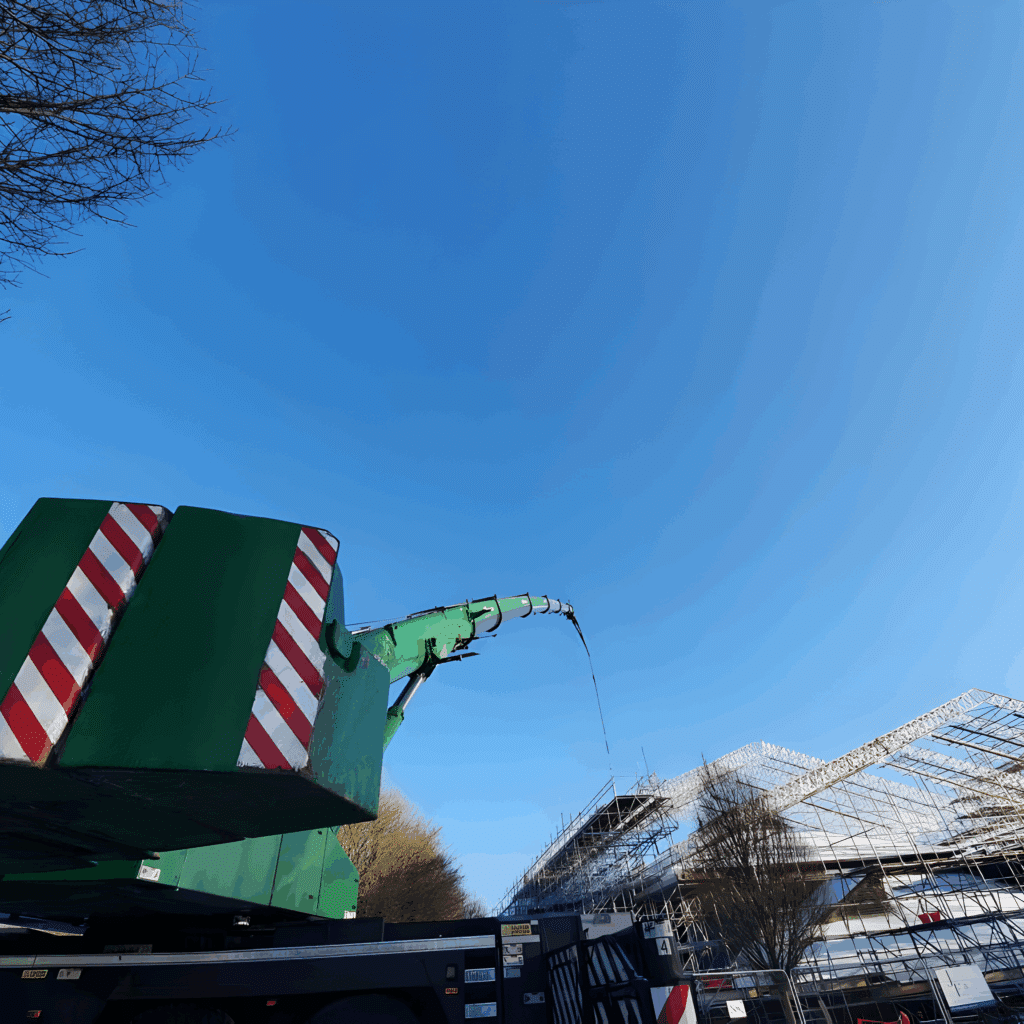
GS6 deals mainly with cranes and lorry loaders, and the crane standards build it into lift planning. BS 7121-1 expects the appointed person to make sure GS6 is followed, and BS 7121-3 applies it to mobile cranes working near lines. Our BS 7121-4 guide sets GS6’s distances against the older ones in the lorry loader standard.
Before a machine move, check the route for overhead lines. A tall load on a low loader can reach them, and so can a telehandler boom, a travelling crane or a tipping lorry body. Where the route passes under a line, set up a goalpost crossing marked with its clearance.
The law
The legal status of GS6
GS6 is guidance. HSE’s note on legal status says following it is not compulsory, but doing so will normally be enough to comply with the law. Regulation 14 of the Electricity at Work Regulations 1989 bars work so near a live conductor that danger may arise unless it is unreasonable for it to be dead and reasonable to work near it live, with suitable precautions to prevent injury.
On construction sites, regulation 25 of the Construction (Design and Management) Regulations 2015 also requires overhead cables to be directed away from the work or isolated and, where necessary, earthed. Where that is not reasonably practicable, warning notices are needed with barriers, suspended protection or equivalent measures. GS6’s list of laws still names the 2007 CDM Regulations, which the 2015 Regulations have since replaced. Northern Ireland has its own equivalents, the Electricity at Work Regulations (Northern Ireland) 1991 and the 2016 Northern Ireland CDM Regulations, enforced on sites by HSENI.
Editions
Editions and how to get GS6
The fourth edition was published in May 2013. HSE says it made the advice easier to follow without changing it fundamentally from the previous version.
GS6 is free to download from HSE’s website as a PDF.
Sources and further reading
Questions
Common questions
What distance from an overhead line does GS6 use?
Work planned within 10 m of the nearest wire, measured horizontally at ground level, needs its risks managed, and barriers sit 6 m either side of the nearest wire where nothing passes beneath. Both figures come from GS6. The law sets no distance.
Who should be contacted before working near an overhead line?
The line’s owner, usually the local electricity network operator, who can confirm the voltage and advise on diversion or switching off. In Northern Ireland that is NIE Networks.
When can work go ahead near a live overhead line?
Under the Electricity at Work Regulations, only when making it dead is unreasonable, working near it live is reasonable, and suitable precautions such as barriers are in place.
Related
Related services and guides
For lifts planned near overhead hazards, see our crane hire and contract lifting service, and for machinery transport and installation, our machine movement service. Call 0800 008 6096 or email office@synergy-lifting.co.uk.
Related
Find out more
Get a quote
Ready for a quote?
Send us the details and we will come back with a quote, usually the same day for a desktop survey.
Or call 0800 008 6096