
Contents
Overview
What CAA CAP 1096 is
CAA CAP 1096 is the UK Civil Aviation Authority’s guidance for crane users on telling aerodromes and the CAA about a crane, and on lighting and marking it so aircraft can see it. The law behind it is the Air Navigation Order 2016. CAP 1096 is guidance on meeting the Order and the CAA’s notification process, and is not law itself.
In short
- The hirer of the crane is responsible for notifying aerodromes and for the crane’s lighting.
- A crane within 6 km of an aerodrome and taller than 10 m, or than its surroundings if higher, is notified, as is any crane 100 m or more tall.
- Planned projects give at least 8 weeks’ notice, and short jobs at least 5 working days.
- Away from aerodromes, the law requires lights only on cranes 150 m or more tall. CAP 1096 recommends lighting lower cranes too.
| Full title | CAP1096: Guidance to crane users on the crane notification process and obstacle lighting and marking |
|---|---|
| Reference | CAP 1096 |
| Current edition | Edition 2.2, 30 April 2021 |
| Publisher | UK Civil Aviation Authority (CAA) |
| Status | Current. Until CAP 1096 is fully implemented, the crane notification page on the CAA website sets the notification steps. |
| Legal status | CAA guidance. The legal duties come from the Air Navigation Order 2016. |
| Northern Ireland | The Air Navigation Order 2016 applies across the UK, and CAP 1096 sets no separate rules for any part of it. |
Audience
Who CAP 1096 is for
The CAA’s crane notification page puts the duty on the hirer of the crane, which is the principal contractor or another contractor, to notify the relevant aerodromes and to light the crane. CAP 1096 covers fixed and mobile cranes alike, once they pass 10 m or the height of their surroundings.
Aerodrome operators use the notifications to protect their airspace. Officially safeguarded aerodromes are consulted on planning applications near them and can set conditions on a crane through their own permits.
Contents
What CAP 1096 covers
The guidance has two parts. The first is notification, where the CAA’s current rules say a crane is notified if it will stand within 6 km of an aerodrome and rise more than 10 m above ground, or above the surrounding buildings and trees if they are higher than 10 m. Any crane 100 m or more above ground is notified wherever it is. The notice periods are:
| Planned projects | At least 8 weeks, or 40 working days, before the crane goes up |
|---|---|
| Short jobs | No later than 5 working days before |
| Urgent work | Contact every aerodrome whose boundary is within 10 nautical miles, then notify through ACOMS as soon as possible |
Individual aerodromes can ask for up to 28 days’ notice and issue a written crane permit that stays with the crane. A crane near an aerodrome that is 100 m or more tall and stays up for more than 90 days is also reported to the Defence Geographic Centre, which keeps the UK database of tall structures.
The second part is lighting and marking. Away from licensed aerodromes, cranes 150 m or more above ground must show steady red medium intensity lights at night under the Order, with intermediate lights no more than 52 m apart. CAP 1096 recommends the same lights from 45 m, and low intensity red lights below that, fitted as close to the top as possible and at both ends of the jib. Where a crane affects an aerodrome’s operations, the aerodrome operator sets the lighting and marking. For daytime, CAP 1096 recommends contrasting bands at least 5 m wide, with yellow and black giving the best contrast.
Lifting
How CAP 1096 applies to lifting and machine moving
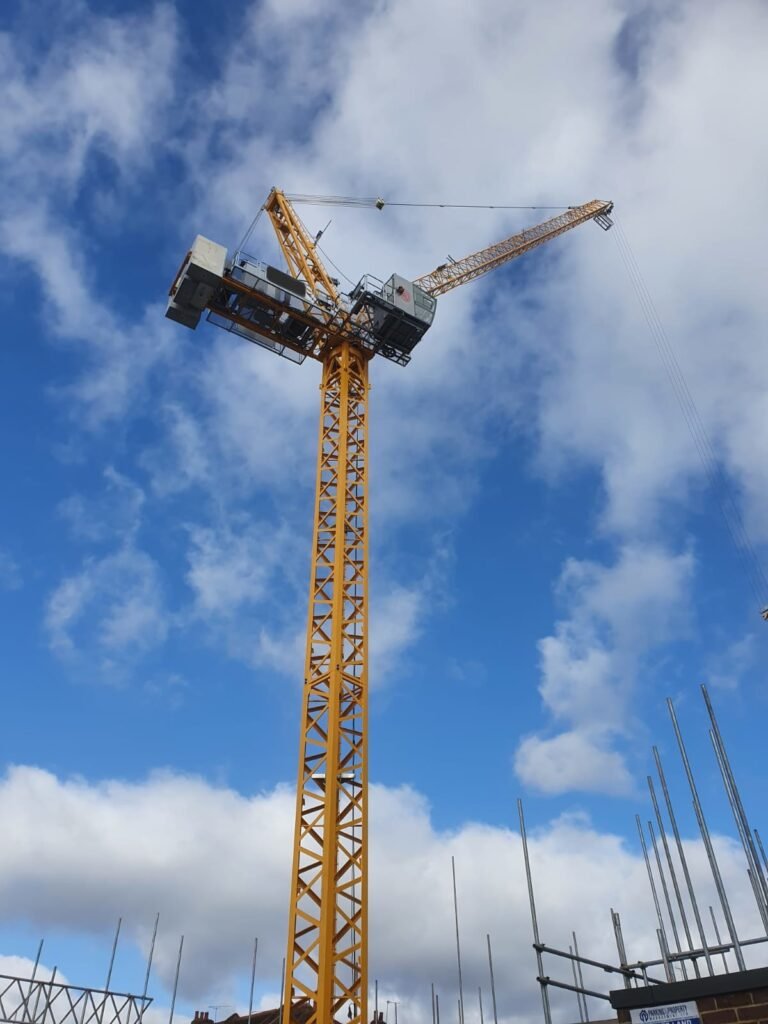
A tower crane is notified at the planning stage; our BS 7121-5 guide covers tower cranes near aerodromes. A mobile crane with a long boom or fly jib passes 10 m as soon as it is rigged, so even a one-day lift near an aerodrome needs 5 working days’ notice.
CAP 1096 also asks crane users to keep the crane as low as the job allows and, where practical, to lower it when it is not in use or when the aerodrome asks. Any conditions in the aerodrome’s crane permit apply as well. A crane put up without a positive response from the CAA or the aerodrome may be treated as a hazard to air navigation.
The law
The legal status of CAP 1096
CAP 1096 is CAA guidance. Most of it is written as recommendations, and its firm requirements come from the Air Navigation Order 2016. Article 222 requires the person in charge of any structure 150 m or more above ground to light it, except near a licensed or certificated aerodrome covered by section 47 of the Civil Aviation Act 1982. Under article 240, it is an offence to act recklessly or negligently in a way likely to endanger an aircraft or anyone in it.
The Order applies across the UK, including Scotland and Northern Ireland. Aerodrome safeguarding in the planning system is set separately in each nation, through the safeguarding Direction in England and Wales, with separate arrangements in Scotland and Northern Ireland.
Editions
Editions and how to get CAP 1096
The CAA will bring CAP 1096 fully into use as its Airspace Co-ordination and Obstacle Management Service (ACOMS) rolls out, with at least 3 months’ notice. Until then, follow the CAA’s crane notification page: notifications are made by registering for ACOMS through the CAA portal, and the older DAP1924 form that CAP 1096 describes is no longer accepted.
CAP 1096 is a free PDF from the CAA’s publications site.
Sources and further reading
Questions
Common questions
When does a crane need notifying under CAP 1096?
When it will be within 6 km of an aerodrome and taller than 10 m, or than the buildings and trees around it if they are higher, and whenever it reaches 100 m or more above ground. The same process applies across the UK.
Who notifies the CAA about a crane?
The crane hirer, as the crane user, through the CAA’s ACOMS service.
When does a one-day mobile crane lift need notifying?
Whenever it meets the height and distance tests. A short job still needs at least 5 working days’ notice, or the urgent route if there is less time.
Related
Related services and guides
For cranes on sites near airports and airfields, see our crane hire and contract lifting service, and for heavy plant installs, our machine movement service. Call 0800 008 6096 or email office@synergy-lifting.co.uk.
Related
Find out more
Get a quote
Ready for a quote?
Send us the details and we will come back with a quote, usually the same day for a desktop survey.
Or call 0800 008 6096