

Contents
Overview
What HSE L22 is
The Provision and Use of Work Equipment Regulations 1998 (PUWER) are the law on equipment used at work. HSE L22 is the Health and Safety Executive’s book on complying with them: it prints each regulation with HSE’s Approved Code of Practice and guidance, which explain what an employer, or anyone else in control of work equipment, should do.
In short
- If you are prosecuted and did not follow the code, you must show you met PUWER another way.
- It covers almost any machine, tool or appliance used at work, including cranes and lift trucks.
- Power presses have their own code, L112, so L22 leaves them out.
- The current text is the fourth edition, free to download from HSE.
| Full title | Safe use of work equipment. Provision and Use of Work Equipment Regulations 1998. Approved Code of Practice and guidance |
|---|---|
| Reference | L22 |
| Current edition | Fourth edition, published 2014, with amendments made in 2018. First published in 1992. |
| Publisher | Health and Safety Executive (HSE) |
| Status | Current |
| Legal status | In Great Britain, an Approved Code of Practice under section 16 of the Health and Safety at Work etc. Act 1974, printed with guidance that is not compulsory |
| Northern Ireland | Approved by HSENI for the Provision and Use of Work Equipment Regulations (Northern Ireland) 1999 |
Audience
Who L22 is for
HSE wrote it for employers and duty holders, and for anyone with direct or indirect control of work equipment, such as managers and supervisors. “Work equipment” in PUWER is broad: a hand tool, a machine on the shop floor, a forklift and a mobile crane all count.
Ship’s equipment is largely outside PUWER, and for vehicles built for the road, HSE says meeting road vehicle law will normally cover the main mobile equipment duties.
Contents
What L22 covers
L22 works through PUWER regulation by regulation, from the general duties to the rules for mobile work equipment. Power presses, regulations 31 to 35, are left to their own code, L112. The regulations are printed in italics and the code in bold, and anything in plain type is HSE’s guidance.
The duties that come up on the shop floor include:
- equipment suitable for the work and the place it is used in (regulation 4)
- maintenance in good repair, with L22 expecting planned maintenance where failing safety-critical parts would put people at risk (regulation 5)
- inspection where safety depends on installation or the equipment can deteriorate, and after exceptional events, with records kept (regulation 6)
- guarding dangerous parts of machinery, starting with fixed guards (regulation 11)
Regulations 25 to 30 deal with mobile work equipment, from carrying people and rollover protection to self-propelled and remote-controlled machines and drive shafts. An appendix gives more detail on guarding machinery.
Lifting
How L22 applies to lifting and machine moving
LOLER, the Lifting Operations and Lifting Equipment Regulations 1998, adds its own duties for lifting equipment, set out in L113, but PUWER still applies. Inspection is split between the two. PUWER’s inspection duty in regulation 6 does not apply to equipment for lifting loads, which LOLER’s thorough examinations cover instead, although HSE says lifting equipment may still need inspecting between examinations. Keeping a crane in good repair stays a PUWER duty under regulation 5.
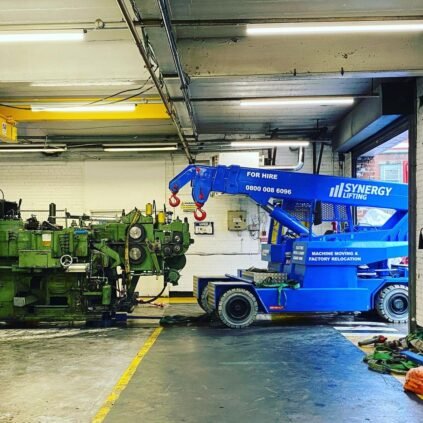
Machine moves rely on equipment that does not lift at all. Skates, rollers, winches and tow tugs used to move a machine along the floor are work equipment, so PUWER’s general duties apply to them in full. When a machine is reinstalled at its new position, regulation 6 calls for an inspection where its safety depends on how it was installed.
Regulation 10 requires equipment first provided for use after 31 December 1992 to keep meeting the product safety law that applied when it was supplied. L22 dates from 2014 and refers to CE marking, before UKCA marking was introduced. For a new machine, see our guide to the Supply of Machinery (Safety) Regulations 2008.
The law
The legal status of L22
HSE approved the code in L22 with the Secretary of State’s consent under section 16 of the 1974 Act. Breaking it is not an offence in itself, but under section 17 a defendant who did not follow the relevant part has to show they complied with the law in some other way, or a court will find them at fault. Scottish prosecutions are for the procurator fiscal.
Following the guidance in plain type is not compulsory unless it says so, and HSE’s note on legal status says that doing so will normally be enough to comply.
Northern Ireland has its own 1999 version of PUWER. HSENI lists L22 among the HSE codes approved for use with it, and enforcement there is by HSENI and the district councils.
Editions
Editions and how to get L22
The fourth edition, of 2014, added short summaries before some regulations and set more of the guidance out in lists. The summaries are for information only and carry no legal status. HSE made further amendments in 2018.
The book is a free PDF from HSE, and printed copies come from HSE Books.
Sources and further reading
Questions
Common questions
Do skates and winches on a machine move come under PUWER?
Yes. They are work equipment, so PUWER’s general duties apply, from suitability to training. LOLER does not apply while the machine stays on the floor.
When does PUWER require equipment to be inspected?
After installation, or assembly at a new site, where safety depends on how it was installed. At suitable intervals and after exceptional events where it can deteriorate dangerously. LOLER covers lifting equipment instead.
What applies in Northern Ireland?
The Provision and Use of Work Equipment Regulations (Northern Ireland) 1999, with L22 approved by HSENI for use alongside them.
Related
Related services and guides
For moving and installing machinery, see our machine movement service, and for lifts, our crane hire and contract lifting service. Call 0800 008 6096 or email office@synergy-lifting.co.uk.
Get a quote
Ready for a quote?
Send us the details and we will come back with a quote, usually the same day for a desktop survey.
Or call 0800 008 6096