

Contents
Overview
What the Manual Handling Operations Regulations 1992 cover
The Manual Handling Operations Regulations 1992 cover any load a person moves or supports at work, so pushing and pulling count as well as lifting and carrying. They give employers an order of steps to follow before anyone handles a load that could injure them.
In short
- Employers avoid manual handling that could injure someone where that is reasonably practicable, and assess and reduce the risk where it is not.
- A mechanical aid cuts the handling without ending it: the crew still push the skates and steady the load on the hook.
- Where a crane or hoist takes the weight, LOLER covers the lift and these Regulations cover the handling left to the crew.
- No weight limit is set in law. HSE publishes guideline figures to help spot the jobs that need a closer look.
| Full title | Manual Handling Operations Regulations 1992 |
|---|---|
| Reference | SI 1992/2793 |
| Current version | The Regulations as amended. legislation.gov.uk lists no outstanding changes to the revised text. |
| Publisher | The National Archives, on legislation.gov.uk |
| Status | In force |
| Legal status | Regulations made under the Health and Safety at Work etc. Act 1974. HSE’s guidance is L23; there is no Approved Code of Practice. Contravening them is a criminal offence. |
| Extent | Great Britain |
| Northern Ireland | Manual Handling Operations Regulations (Northern Ireland) 1992 |
Duty holders
Who has duties under the Regulations
The duties in regulation 4 fall on employers, for their own employees. Under regulation 2 they also apply to a relevant self-employed person, defined below, for their own manual handling. Employees must make full and proper use of any system of work their employer provides to reduce the risk, such as agreed handling aids and team sizes (regulation 5).
The Regulations do not apply to the master or crew of a sea-going ship, or their employer, for the crew’s normal ship-board work under the master’s direction (regulation 3). The exemption does not reach shore-side workers loading or unloading a vessel, so their employers keep these duties. The Secretary of State for Defence can, by written certificate, exempt home or visiting forces in the interests of national security (regulation 6).
Requirements
What the Regulations require
The steps in regulation 4
| Avoid | So far as is reasonably practicable, avoid the need for employees to do manual handling that involves a risk of injury. |
|---|---|
| Assess | Where that handling cannot be avoided, make a suitable and sufficient assessment of it. HSE’s guidance, L23, reads this as covering every type of manual handling employees do and the factors listed below. |
| Reduce | Take steps to reduce the risk of injury to the lowest level reasonably practicable. |
| Inform | Tell employees roughly what each load weighs and, where reasonably practicable, the exact weight and which side is heavier when the centre of gravity is off-centre. |
What the assessment covers
Schedule 1 lists the factors an assessment must consider. They include:
- The task: holding the load away from the body, twisting, stooping or reaching up, excessive lifting, lowering or carrying distances, excessive pushing or pulling, the risk of the load moving suddenly, and frequent or prolonged effort with too little rest.
- The load: whether it is heavy, bulky or unwieldy, hard to grip, unstable or with contents likely to shift, or sharp, hot or otherwise likely to cause harm.
- The working environment: space to move, uneven or slippery floors, changes in level, temperature and humidity, ventilation and gusts of wind, and lighting.
- Individual capability and other factors: whether the job needs unusual strength or height, or special information or training, whether it puts at risk someone who is pregnant or has a health problem, and whether protective equipment or clothing restricts movement.
Since a 2002 amendment, regulation 4(3) lists what the employer must take into account when deciding whether a person is at risk, including their physical suitability, their clothing and footwear, their training, and the results of the risk assessment under the Management of Health and Safety at Work Regulations 1999.
Lifting
How the Regulations apply to lifting and machine moving
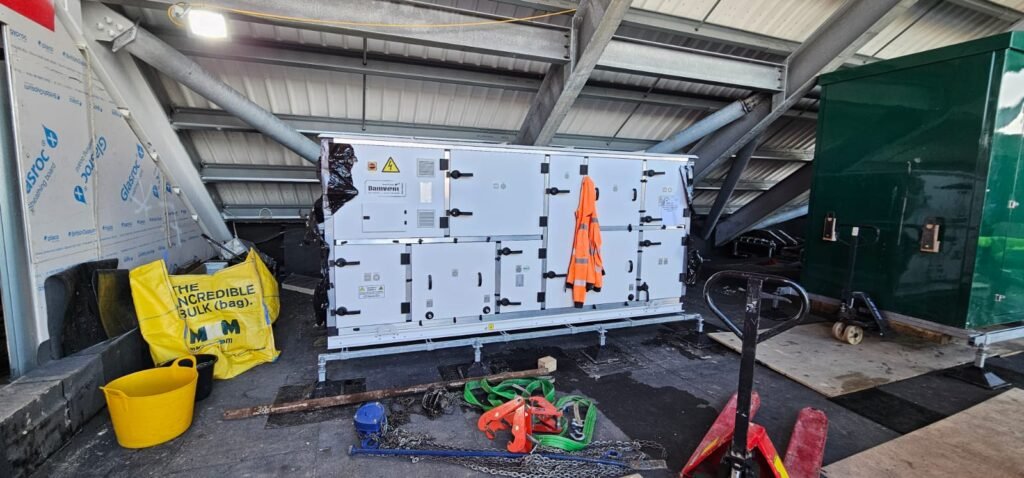
L23 says a mechanical aid such as a sack truck or a powered hoist may reduce manual handling without removing it, because people still move the aid or steady and position the load on it. On a machine move, the crew still handle the load. They push it on skates or a pallet truck, and steady it on the hook.
- Pushing and pulling are part of the definition, so a move along a factory floor can need assessing for the force it takes to get the load moving and to stop it. L23’s guideline figures are about 200 N (20 kg) for men and 150 N (15 kg) for women at the start and stop, and 100 N (10 kg) and 70 N (7 kg) once moving. HSE’s Risk Assessment of Pushing and Pulling (RAPP) tool covers pushing and pulling wheeled equipment and moving a load without wheels.
- A team can handle a load that is beyond one person. As a rough guide, L23 suggests a team handles no more than about 85% of the total its members could each manage alone.
- Where any dimension of a load exceeds about 75 cm, L23 treats handling it as likely to raise the risk of injury.
- Where a hoist or crane takes the weight, the Lifting Operations and Lifting Equipment Regulations 1998 (LOLER) cover the lift and the lifting equipment, and the Provision and Use of Work Equipment Regulations 1998 (PUWER) apply to that equipment as well. Trolleys and skates are work equipment under PUWER.
Definitions
Key definitions
- Manual handling operations: any transporting or supporting of a load, including lifting, putting down, pushing, pulling, carrying or moving it, by hand or by bodily force (regulation 2).
- Load: includes any person and any animal.
- Injury: does not include injury from a toxic or corrosive substance in or on the load, or one that has leaked or spilled from it. The Control of Substances Hazardous to Health Regulations 2002 (COSHH) deal with those.
- Relevant self-employed person: a self-employed person whose work is of a kind listed in the regulations made under section 3(2) of the Health and Safety at Work etc. Act 1974, which include construction work.
Enforcement
Enforcement and penalties
Depending on the workplace, HSE or the local authority enforces the Regulations. In Great Britain, a breach is an offence under section 33 of the Health and Safety at Work etc. Act 1974; our guide to that Act covers notices and penalties. In Scotland, the Crown Office and Procurator Fiscal Service decides whether to prosecute.
In Northern Ireland the Manual Handling Operations Regulations (Northern Ireland) 1992 (SR 1992/535) apply, enforced by HSENI and the district councils, each for its own types of workplace.
Guidance
Guidance and sources
HSE’s guidance is L23, Manual handling: Manual Handling Operations Regulations 1992, Guidance on Regulations, fourth edition, 2016. Following it is not compulsory unless it says a step is, and if you do follow it you will normally be doing enough to comply.
HSE’s assessment tools include the Manual handling Assessment Charts (MAC) for lifting, lowering, carrying and team handling, and RAPP for pushing and pulling. Its free leaflet Manual handling at work: a brief guide (INDG143) gives the guideline weights.
Sources and further reading
Questions
Common questions
What is the maximum weight a person can lift at work?
The law sets none. HSE’s guideline figures for lifting and lowering in INDG143 run from 25 kg for men and 16 kg for women, for a load held close to the body at knuckle height, down to 5 kg and 3 kg at shoulder height with the arms extended. They assume a load that is easy to grip, good working conditions and a stable posture. HSE says they are not safe limits. A job above them, or one involving twisting or lifts more often than once every two minutes, needs a more detailed assessment.
What counts as manual handling when a crane takes the weight?
Whatever the crew do by hand: guiding and landing the load, and carrying slings and shackles to the hook.
When does a manual handling assessment need reviewing?
Under regulation 4(2), the employer reviews it if there is reason to suspect it is no longer valid, or if the work has changed significantly, and updates it where the review shows a change is needed.
Related
Related services and guides
For moving plant and machinery, see our machine movement service, and for the lift, crane hire and contract lifting. Call 0800 008 6096 or email office@synergy-lifting.co.uk.
Get a quote
Ready for a quote?
Send us the details and we will come back with a quote, usually the same day for a desktop survey.
Or call 0800 008 6096