

Contents
Overview
What BS 7121-5 is
BS 7121-5 is the British Standard code of practice for using tower cranes safely, self-erecting tower cranes included.
In short
- It is a code of practice, not law, and is read together with BS 7121-1.
- UK practice is to start taking a tower crane out of service at 38 mph (16.5 m/s), below a typical design limit of 45 mph.
- Out of service, the hook is usually left empty and the crane free to slew with the wind.
- On a construction site, the principal contractor must make sure rescue arrangements are in place.
| Full title | Code of practice for safe use of cranes — Part 5: Tower cranes |
|---|---|
| Reference | BS 7121-5:2019 |
| Current edition | Published 30 September 2019. It replaced BS 7121-5:2006. |
| Publisher | BSI (BSI Standards Limited) |
| Status | Current |
| Legal status | British Standard code of practice. Its recommendations have no legal force of their own. |
| Intended for | Lifting operations with tower cranes anywhere in the UK |
Scope
What BS 7121-5 applies to
The standard covers tower cranes of every kind, including self-erecting tower cranes, with an annex describing the types. Its subjects include selection, erection, extension and climbing, dismantling, maintenance and thorough examination, operation, and the planning of lifts. Mobile self-erecting tower cranes, which travel on their own carrier, are left to BS 7121-3.
Planning
Planning and running tower crane lifts
As in BS 7121-1, an appointed person plans the lifts and places each in a category from basic to complex; a blind lift, where the operator cannot see the load, is given as an example of an intermediate lift. On a large site with several contractors, the principal contractor’s appointed person leads, though each lift plan stays its author’s responsibility.
- Coordination: where cranes share a site, a crane coordinator plans the day’s movements. Anti-collision electronics back that planning up, with daily and weekly checks signed by the operator.
- Clearances: where cranes overlap, at least 3 m between any parts of them, or 600 mm plus the manufacturer’s allowance for deflection.
- Heavy use: days over 10 hours, more than six lifts an hour, frequent use above 70% of capacity or a mast of 20 m or less signal heavy use. Repeated loads should stay within 70% to 80% of rated capacity, and the standard calls planning lifts above 90% bad practice.
- Restricted work: special duties such as grabbing, magnet work, demolition balling and piling should not be carried out. Multi-crane lifts are kept for exceptional cases.
Wind
Wind limits and the out-of-service crane
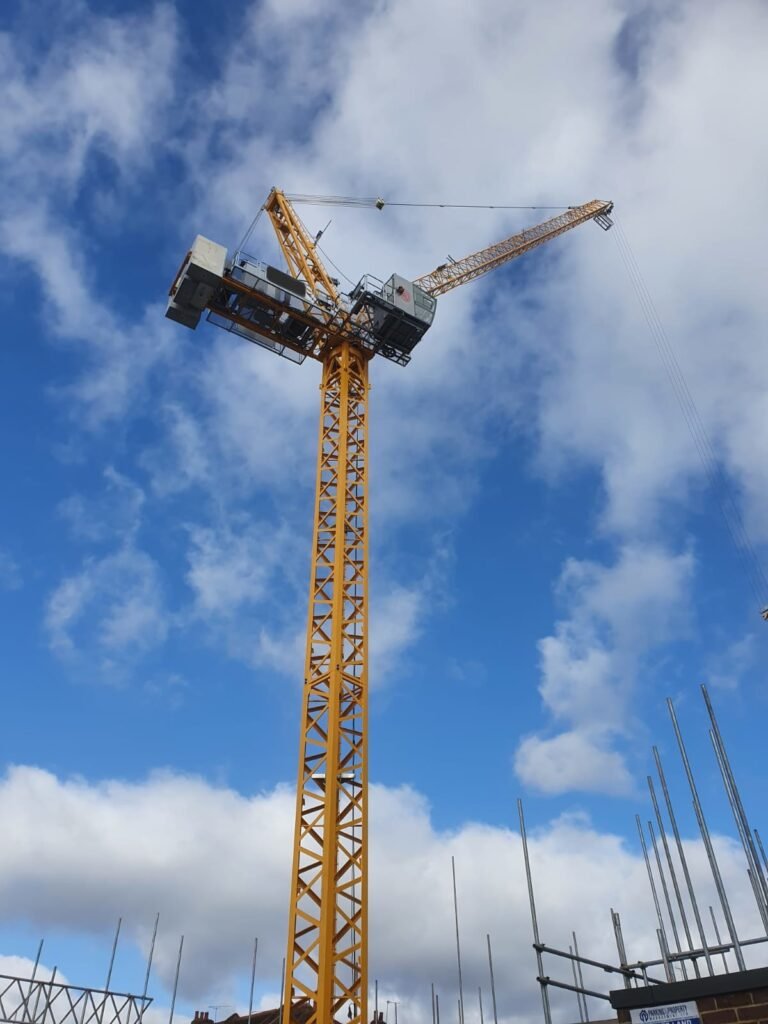
Tower cranes are commonly designed to work up to 20 m/s (45 mph). The standard records UK industry practice of starting to take the crane out of service at 16.5 m/s (38 mph), with an amber warning set no higher than 32 mph and red no higher than 38 mph, and lower limits for large, light loads. The operator’s decision to stop cannot be overruled by site management, and the operator climbs back up only once the wind has stayed below 38 mph and been falling for 10 minutes. Most forecast wind speeds are for 10 m above ground and need correcting for the height of the jib.
Out of service, the hook is left empty unless the manufacturer requires otherwise, and the crane is left free to slew. The power is isolated overnight. Where an indicator light is fitted, green shows free slew and white shows the slew is locked. Every tower crane should have lightning protection.
Erection
Erection, climbing, aerodromes and rescue
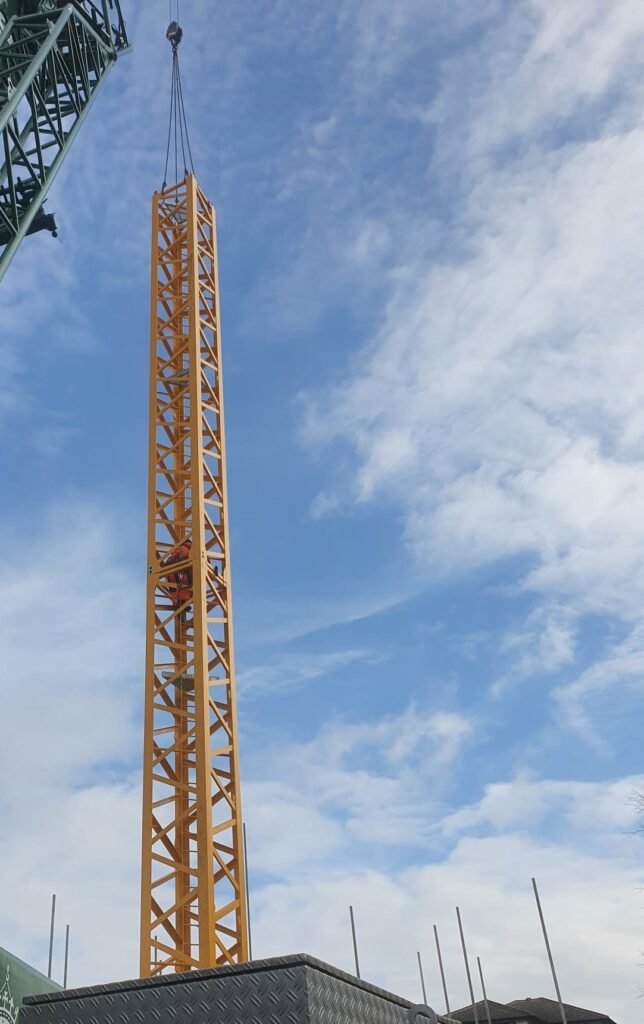
Bases and ties are designed by a competent engineer for the manufacturer’s worst load case and UK out-of-service wind. An erection supervisor controls erection, and the principal contractor sets and enforces the exclusion zone. Erection and dismantling are not carried out in darkness, and climbing takes place only below the manufacturer’s wind limit for it.
A crane within 6 km of an aerodrome that will stand taller than 10 m or its surroundings needs notifying. The standard asks for 28 days’ notice to the aerodrome, but the Civil Aviation Authority now asks for at least eight weeks, and any crane 100 m or taller must be notified to it wherever it stands.
A rescue plan should not depend on the fire service. On a construction site the principal contractor has the primary duty to make sure rescue arrangements are in place, agreed with the crane supplier, and rescue training is refreshed at least every six months.
The law
How BS 7121-5 relates to LOLER and PUWER
The foreword names LOLER and PUWER and HSE’s Approved Codes of Practice for them, now L113 and L22. Inspection and thorough examination follow BS 7121-2-1 and 2-5, and regulation 9 of LOLER sets the legal intervals. HSE’s safety bulletins on luffing jib tower cranes and releasing slew brakes refer to the 2006 edition of this part.
Complying with the standard does not take away any legal duty. LOLER and PUWER apply in Great Britain; Northern Ireland has its own 1999 versions, such as the Lifting Operations and Lifting Equipment Regulations (Northern Ireland) 1999.
Editions
Editions and related parts
The 2019 edition is a full revision of the 2006 one. Its foreword says it was aligned with BS 7121-1:2016 and draws on technical notes from the Construction Plant-hire Association; BSI’s list of changes includes lift categories, climbing, wind, bases and ties, operator access and rescue.
Sources and further reading
Questions
Common questions
When does a tower crane stop working in the wind?
Below the manufacturer’s limit, and sooner for loads that catch the wind. UK practice is to begin taking the crane out of service at 38 mph, and the operator’s decision cannot be overruled.
Who is responsible for rescue from a tower crane?
On a construction site, the principal contractor must make sure rescue arrangements are in place, agreed with the crane supplier at the start of the job.
When does a tower crane near an aerodrome need notifying?
When it stands within 6 km of the aerodrome and will be taller than 10 m or its surroundings. The CAA asks for notice at least eight weeks before erection, longer than the standard’s 28 days.
Related
Related services and guides
For lifting with tower cranes or mobile cranes, see our crane hire and contract lifting service. Call 0800 008 6096 or email office@synergy-lifting.co.uk.
Get a quote
Ready for a quote?
Send us the details and we will come back with a quote, usually the same day for a desktop survey.
Or call 0800 008 6096